


Global Status Report
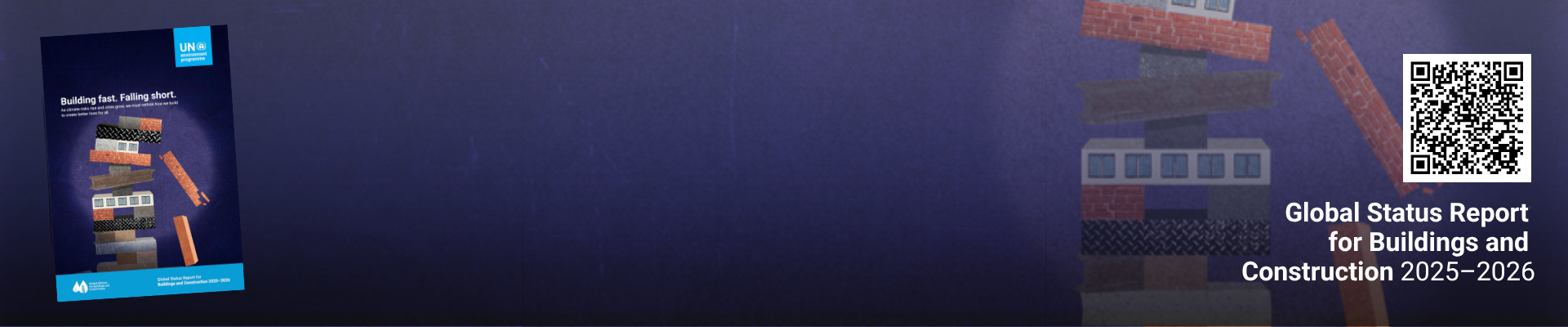
Global Status Report for Buildings and Construction 2025–2026
Launched at the 13 session of the World Urban Forum, UNEP and the Global Alliance for Buildings and Construction (GlobalABC)'s tenth edition of the Global Status Report for Buildings and Construction 2025–2026 examines one of the defining challenges of this decade: transforming a rapidly expanding, emissions-intensive sector into one that delivers climate action, resilience and affordable living.
Buildings and construction sit at the centre of the global economy, representing 11–13 per cent of global GDP and employing around 9 per cent of the world’s workforce across construction, renovation, demolition and engineering. At the same time, the sector accounts for around 37 per cent of global CO₂ emissions and nearly 50 per cent of global material extraction.
With half of the buildings that will exist in 2050 still yet to be built or renovated, the choices made today will shape emissions, energy use and quality of life for generations.
Tracking policies, technologies and investment against a 2050 net-zero pathway, the report reveals both progress and urgency: global building energy intensity has fallen by 8.5 per cent and green building certifications have nearly tripled over the last decade, yet investment in energy efficiency must more than double, reaching US$5.9 trillion by 2030, to keep climate goals within reach.
Read the UNEP Press Release and UNEP Webstory: Could this self-cooling mosque be the future of construction in a warming world?
Every day, the world builds an estimated 12.7 million square metres of floor area –roughly the equivalent of adding the entire city of Paris in new floor space nearly every week.
In 2024, the global buildings floor area expanded by 1.7 per cent, reaching 273 billion square metres. This rapid growth was driven largely by construction in emerging economies, including India and Southeast Asia. The buildings and construction sector now accounts for nearly 50 per cent of global material extraction, 37 per cent of global emissions, and 28 per cent of global energy consumption.
• Global building energy intensity – measuring a building's annual energy consumption relative to its size – has reduced by 8.5 per cent.
• Green building certifications have nearly tripled.
• In 2024, renewables supplied just 17.3% of buildings’ energy demand, far below what is needed for a net-zero pathway.
• Investment in energy efficiency reached USD 275 billion in 2024, contributing to cumulative investment of USD 2.3 trillion since 2015.
Download the Global Status Report for Buildings and Construction (2025-2026) and Key Messages here
Since 2020, however, progress has slowed, as the green transition has not kept pace with the rate of construction. To align the sector with a net-zero pathway, policymakers should accelerate energy efficiency improvements, and the fossil fuel phase out, while investment in building energy efficiency must reach USD 5.9 trillion by 2030, equivalent to USD 592 billion annually.
The report highlights positive examples across regions, including:
• The European Union deployed policies tackling operational emissions and emissions released before and during construction (embodied emissions). Improvements in building energy performance in Japan and Switzerland.
• Growth in on-site renewables in buildings in Australia, Germany, India, and Pakistan.
• National climate action plans (NDCs) substantively covering building sector strategies in the Bahamas, Cambodia, and Colombia.
• Updated building energy codes in California, Kenya, Japan, and Singapore.
• Expansion of green building certification in China, Colombia, India, and Türkiye.
• National roadmaps supporting sector transformation in Bangladesh, India, Indonesia, Jordan, Ghana, and Senegal.
• Growth in investment and financing for sustainable buildings in Canada, New Zealand, and the United Kingdom.
UNEP and GlobalABC will continue working to strengthen data, improve methodologies and support national policymaking. These efforts will equip decision-makers with the evidence needed to accelerate climate action while addressing affordability and equity challenges.
About the Global Status Report for Buildings and Construction
The Global Status Report for Buildings and Construction (GSRBC) is a flagship publication of the UNEP and the Global Alliance for Buildings and Construction (GlobalABC). The GSRBC provides an annual snapshot of the progress of the buildings and construction sector on a global scale and reviews the status of policies, finance, technologies, and solutions to monitor whether the sector is aligned with the Paris Agreement goals. It also provides stakeholders with evidence to persuade policymakers and the overall buildings and construction community to take action.
- The Global Status Report for Buildings and Construction 2024/2025
This year's edition introduces exciting new features, spotlighting the Buildings Breakthrough Initiative and the Declaration De Chaillot, reinforcing global efforts to accelerate progress in sustainable building practices. Read the 2024-2025 edition of the Global Status Report for Buildings and Construction here.
Key Updates:
- The Buildings and construction sector saw a modest emissions reduction in 2023, despite a 3% rise in floor area, but a decline in energy efficient investment.
- The global Building Carbon Tracker highlights limited sectoral progress, despite positive improvements in renewables, codes and certifications.
- Since 2023, over 14 countries/sub-national governments have updated building codes, but few align with net zero goals.
- National commitments and policies remain insufficient, but initiatives like the Buildings Breakthough, Declaration De Chaillot, and Global Cooling Pledge, offer crucial pathways for progress.
The Energy Intensity of the buildings sector is 11% above the required target to get back on track.

- Since 2915, energy intensity has decreased by only 9.5%
- By 2023, the energy intensity is 11% higher than the target value to progress towards the goal.
- The gap between between the achieved and target energy intensity has increased by an average of 43% annually since 2016.
In 2023, global buildings operation and construction energy demand decreased by around 1% from 2022 to 143 EJ

- Energy used in buildings operation (e.g. space heating and cooling, water heating, lighting, cooking and other uses) account for 32% of global demand in 2023, representing only a 1% reduction from last year.
- Although many NDCs mention buildings, only a limited number offer comprehensive details regarding energy efficiency, building codes, or adaptation measures

As of 2023, the aggregate proportion of NDCs addressing building energy efficiency, codes, and adaptation measures in detail is only 6.3%By 2023, only 19 countries have NDCs considering buildings in detail. The sector’s progress shortfall to the Paris Agreement Goals has increased by a staggering average of 34% annually since 2016. In 2023, 38 parties updated their NDCs, with around 80% of NDCs citing actions for the buildings and construction sector, and 19 NDCs having extensive details. Since the 2023 GSR, three parties adjust or update their NDCs, Panama, Madagascar and Namibia
- Consult previous GSR editions


