


Under the leadership of the Ministry of Housing and Public Works (MoHPW), the United Nations Environment Programme (UNEP), the United Nations Office for Project Services (UNOPS), and the United Nations Human Settlements Programme (UN-Habitat) are jointly implementing the project Transforming the Built Environment through Sustainable Materials in Bangladesh, funded by the German Federal Ministry for Economic Cooperation and Development (BMZ). The initiative aims to support Bangladesh in decarbonizing the building and construction sector through the adoption of resource-efficient, circular, and climate-resilient practices.
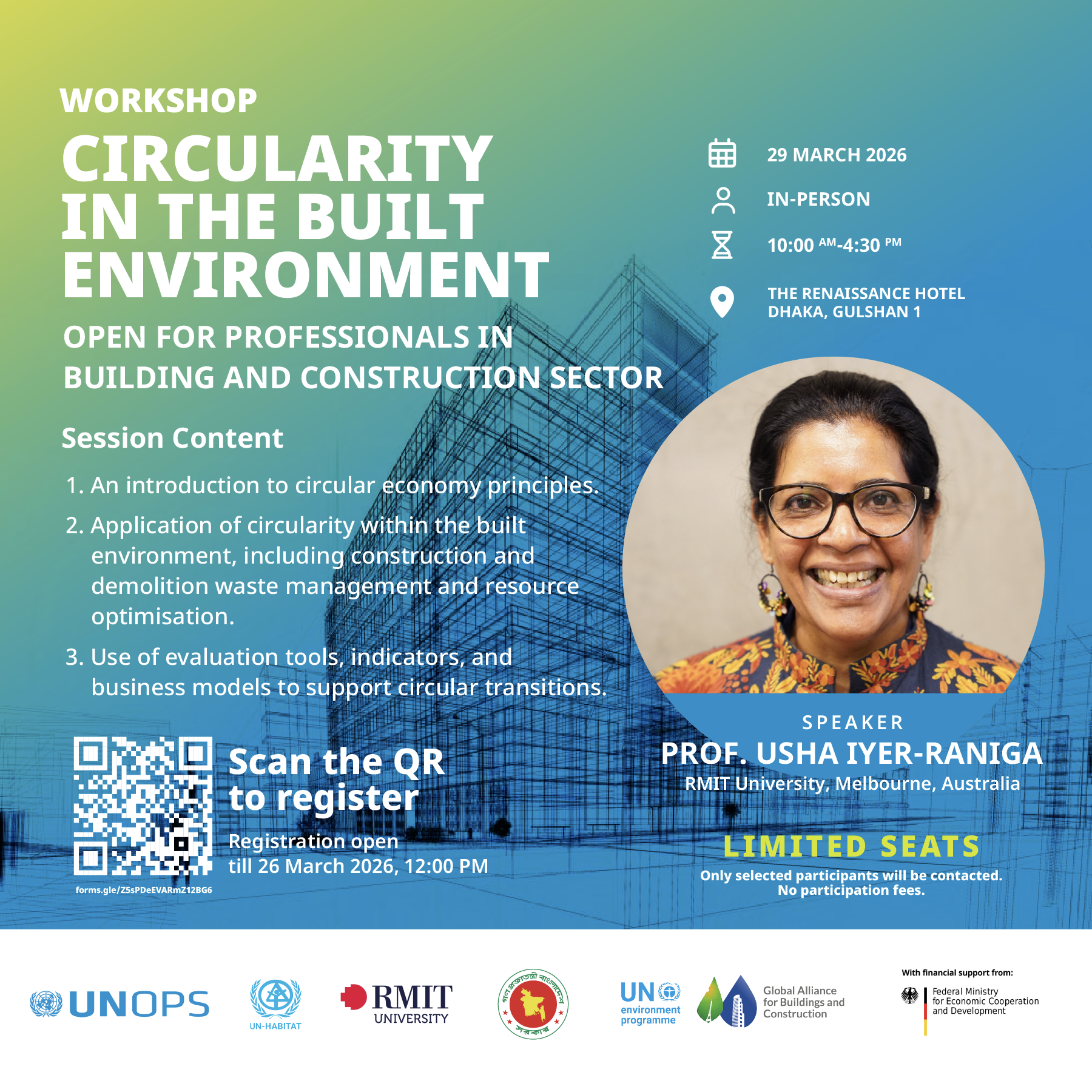
In this context, a one-day training workshop on circularity in the built environment will be held in Dhaka, Bangladesh on 29 March 2026. This training is organized as part of the capacity-building initiatives under the project, aimed at enhancing the knowledge and practical understanding of stakeholders across government, academia, and industry on circular economy (CE) principles and their application in the building and construction sector.
The workshop responds to the growing need to address rapid urbanisation and infrastructure expansion in Bangladesh, which are intensifying material consumption and environmental pressures. Advancing circularity in this context is both timely and strategic.
The Dhaka workshop builds on insights from the pilot training delivered in Delhi under the same initiative, which highlighted the importance of contextual adaptation, stakeholder engagement, and translation of CE principles into practical strategies. Drawing on these lessons, the Dhaka programme is tailored to Bangladesh’s institutional and urban development context. Moving beyond a narrow focus on material substitution, it examines how governance, design processes, cross-sector collaboration, business models, and evaluation frameworks can collectively enable systemic change.
Learning Outcomes
LO1: Critically reflect upon major economic, social and environmental challenges facing the built environment.
LO2: Formulate a range of possible responses to built environment projects, incorporating circular economy principles and concepts.
LO3: Propose strategies to engage diverse disciplines and organisational cultures in meeting circular economy outcomes/targets.
LO4: Analyse and evaluate circular economy solutions by drawing on relevant data and theoretical frameworks.
LO5: Define and communicate, to a diverse range of stakeholders, the benefits of the circular economy and its application to sustainability in the built environment.
The workshop is coordinated by the UNOPS Bangladesh Country Office and the School of Property, Construction and Project Management at RMIT University, and facilitated by Prof. Usha Iyer-Raniga, with support from her team in Melbourne, including Dr Akvan Gajanayake and Dr Jayawardanage Janappriya Lakmal Jayawardana
Register here: https://forms.gle/ypx9qqGfutrW2uho9


