



Near-Zero Emission and Resilient Buildings Plan to Accelerate Solutions (NZERB PAS)
The Near-Zero Emission and Resilient Buildings Plan to Accelerate Solutions (NZERB PAS), launched at COP30 in Belém, is a global action framework coordinated by the UNEP-hosted Global Alliance for Buildings and Construction (GlobalABC) secretariat with a shared ambition: near-zero emission and resilient buildings the new normal by 2030.
Background
- What is the NZERB PAS?
The PAS brings together governments, cities, financial institutions, industry and international/regional organisations around coordinated actions to accelerate the transformation of the buildings and construction sector by 2030. The PAS is organised around a common set of priorities and connects political priorities with technical expertise, financing and implementation support across the sector’s ecosystem.
It is a living framework, evolving as implementation and sector priorities progresses, and as gaps are identified and addressed through newly suggested actions. Rather than creating new initiatives, it connects, coordinates and elevates existing efforts across the buildings' value chain.
The PAS supports stakeholders to:
align around shared implementation priorities;
identify gaps and systemic barriers;
coordinate complementary actions and reduce duplication;
connect political priorities with technical and financial solutions;
support stakeholders in translating commitments into implementation; and
accelerate market transformation towards near-zero emission and resilient buildings.
The PAS addresses mitigation and resilience across the whole life cycle of buildings, covering both new construction and deep renovation. Its scope is global, with particular emphasis on supporting implementation in Emerging Markets and Developing Economies (EMDEs).
- How we got here ?
The NZERB PAS is the result of several years of international cooperation that progressively moved the buildings sector from a shared ambition towards coordinated implementation.
2021 | Breakthrough Agenda
Launched at COP26, the Breakthrough Agenda established a framework for stronger international cooperation across major emitting sectors, with the aim of making clean technologies and sustainable solutions more affordable, accessible and attractive worldwide.
2023 | Buildings Breakthrough
At COP28, France and Morocco launched the Buildings Breakthrough, coordinated by GlobalABC, around a common goal: Near-Zero Emission and Resilient Buildings are the new normal in all regions by 2030.
Priority International Actions subsequently mobilised governments and partners around key implementation barriers including standards, demand, finance, deployment and capacity.
2024 | Déclaration de Chaillot and ICBC
At the first Buildings and Climate Global Forum in Paris, governments adopted the Déclaration de Chaillot, reinforcing political cooperation on the decarbonisation and climate resilience of buildings.
The Declaration called for the establishment of the Intergovernmental Council for Buildings and Climate (ICBC), which was formally launched at COP29 as a dedicated government-led platform for buildings and climate.
2025 | NZERB Plan to Accelerate Solutions
At COP30, the NZERB PAS brought the work initiated through the Buildings Breakthrough together with GlobalABC programmes and partner initiatives under a common implementation framework.
The earlier Buildings Breakthrough actions are now reflected across five interconnected PAS priority areas, while coordination across the wider buildings ecosystem is embedded throughout the framework rather than treated as a separate workstream.
The emphasis has therefore shifted from defining ambition and priority actions to coordinating implementation and tracking progress.
Five Priority Areas
The PAS provides a common direction for collective action while bringing together GlobalABC working groups, members and partners around five interconnected priority outcomes.
- 1. Standards and Certification – create the foundation for NZERBs
Establishing a shared global framework of NZERB definitions, principles, indicators, and policy guidelines, built on and aligned with existing standards, certifications, and initiatives, to give governments a common foundation for policy implementation.
Facilitating Partner: World Green Building Council (WorldGBC)
GlobalABC Hubs and Actions Groups support: Adaptation Hub, Data Hub, Market Transformation Hub, Materials Hub, Sufficiency Hub, Passive Cooling Action Group
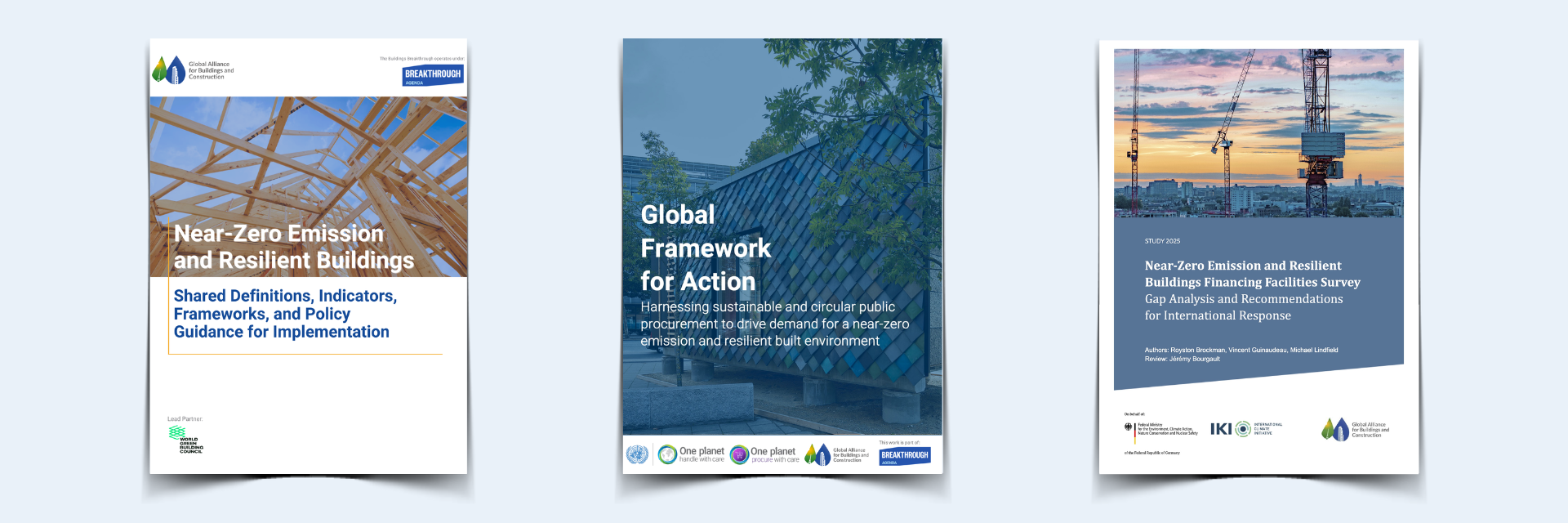
Key outputs: Near-Zero Emission and Resilient Buildings: Shared Definitions, Indicators, Frameworks, and Policy Guidance for Implementation (April 2026): coordinated by GlobalABC and led by the World Green Building Council (WorldGBC), establishing a globally aligned framework of definitions, principles, metrics, and policy recommendations to support adoption of NZERBs.
- 2. Demand Creation – create markets for high-performance buildings
Procurement is one of the most powerful levers governments hold. The PAS helps public institutions translate that leverage into NZERB-aligned commitments, for new buildings and deep renovation alike, while aligning procurement policies with standards for clean and efficient heating and cooling.
Facilitating Partner: One Planet Network
GlobalABC Hubs and Actions Groups support: Clean Heat Forum, Materials Hub
Key outputs: Global Framework for Action on Circular and Sustainable Public Procurement for the Built Environment (May 2025), developed with the GlobalABC Materials Hub and the One Planet Network. Country-level implementation is supported through online training modules, technical webinars, and regional capacity-building sessions in Latin America and Africa.
- 3. Finance and Investment – turn ambition into investable programmes
Supporting countries, in particular EMDEs, to expand international financial and technical assistance programmes that address blended finance instruments, policies, and the capacity of local banks and lenders.
Facilitating Partners: Partnership for Energy Efficiency in Buildings (PEEB) & International Finance Corporation (IFC)
GlobalABC Hubs and Actions Groups support: Finance Hub
Key outputs:
- NZERB Financing Facilities Landscape Survey (April 2026), mapping the landscape of technical assistance and finance solutions, with a focus on how finance can be better structured, coordinated, and channelled toward impactful building projects.
- “Article 6’ Implementation Handbook for Buildings led by the Partnership for Energy Efficiency in Buildings (PEEB), to help mobilise climate finance for energy efficiency in buildings across EMDEs.
- The launch of a PEEB (AFD/GIZ) initiative to strengthen banks' institutional capacity to finance NZERBs, beginning in Mexico and expanding to additional countries.
- 4. Research and Deployment – advance research priorities and move proven solutions in the market
Accelerating project deployment at national and regional levels, with a focus on finance-ready projects, particularly in developing regions.
Governments are supported to increase annual renovation rates, with priority given to deep renovation. Regional demonstration projects translate global guidance into local implementation, creating replicable models.
Facilitating Partners: UNU Flores, Solar Impulse Foundation
GlobalABC Hubs and Actions Groups support: Higher Education Institutions Action Group
Key outputs:
- Catalogue of Climate Solutions for Buildings (Solar Impulse Foundation), launched at COP30, profiling finance-ready, scalable solutions for deployment across the buildings sector.
- Blueprint for a Solutions Deployment Platform, launched at COP29, setting out the architecture for a coordinated platform to accelerate project deployment at national and regional levels.
- 5. Capacity and Skills – build the capacity to deliver
Strengthening institutional, educational, and enforcement systems to build the skills and knowledge base needed for sector-wide transformation.
This includes the roll-out of online capacity-building modules, regional training sessions, the GlobalABC Knowledge Platform, and engagement with the GlobalABC Higher Education Institutions Action Group.
Facilitating Partners: International Code Council (ICC)
GlobalABC Hubs and Actions Groups support: Higher Education Institutions Action Group, Subnationals Action Group
Key outputs:
- NZERB training and capacity-building priorities mapped and resources (ICC), a collection of tools and resources supporting capacity-building, skills development and NZERB implementation through the GlobalABC Knowledge Platform.
Who drives the PAS?
The PAS is implemented through a delivery ecosystem that brings together political direction, technical delivery, coordinated implementation and progress tracking.
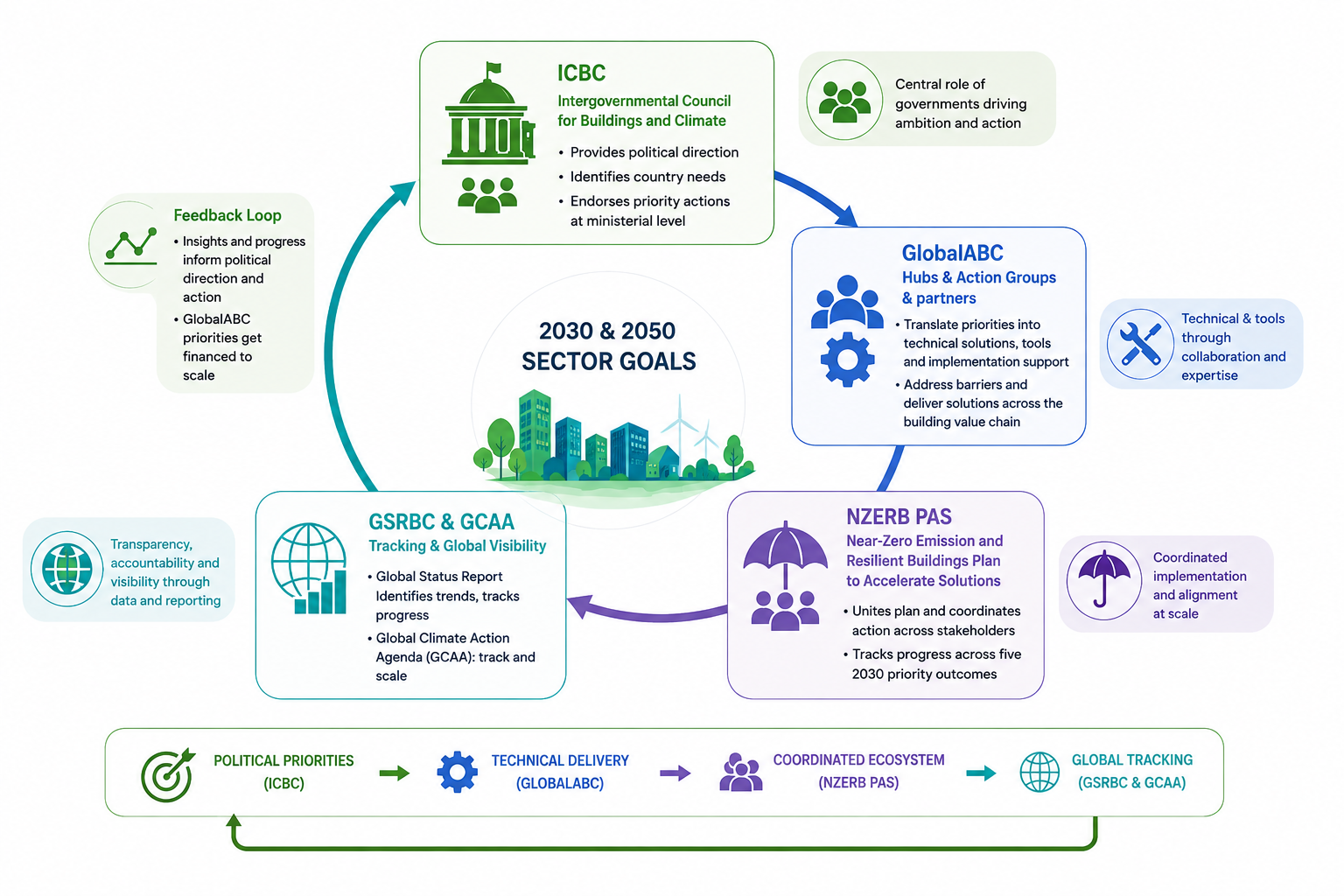
- ICBC provides the government-led political platform, where countries identify needs and priorities and provide political direction;
- GlobalABC Hubs, Action Groups, members and partners translate priorities into technical guidance, tools, capacity-building, financing approaches and implementation support;
- NZERB PAS aligns these efforts around five priority areas, identifies implementation gaps and supports coordinated delivery; and
- GSRBC and GCAA processes help track progress, identify gaps and connect implementation to wider global climate action.
Evidence and implementation experience feed back into future political and technical priorities, creating a continuous cycle between ambition, delivery and progress tracking.
- Alignment with the Global Climate Action Agenda
The Global Climate Action Agenda is the UNFCCC’s framework for mobilising coordinated action by Parties and non-Party stakeholders to accelerate implementation of the Paris Agreement. In COP30, and within this framework, the Global Climate Action Agenda (GCAA) introduced Plans to Accelerate Solutions (PAS), which are a new tool to provide actionable, time-bound pathways to accelerate implementation of climate action that provide continuity from COP to COP, and support tracking towards the next Global Stocktake.
The Near-Zero Emission and Resilient Buildings Plan to Accelerate Solutions (NZERB PAS) was submitted as part of this framework and serves as the umbrella plan focused on 2030 priorities. It provides a structured interface between:
political engagement through the ICBC (where relevant actions are brought forth to governments),
technical delivery through GlobalABC Hubs and Action Groups and partners,
a wide range of stakeholders, including governments, cities, industry, and finance actors, to drive systemic change across the sector
sectoral efforts and global coordination under the Global Climate Action Agenda (GCAA).
Progress since COP30
Since the launch of the NZERB PAS at COP30, implementation has advanced across all five priority areas.
publication of globally aligned NZERB definitions, indicators and implementation guidance;
publication of the NZERB Financing Facilities Landscape Survey;
political recognition of key technical outputs through the ICBC Ministerial process;
expansion of sustainable public procurement training and regional implementation activities;
initiatives to strengthen financial institutions' capacity to finance NZERBs;
development of passive cooling guidance supporting national implementation;
continued development of implementation, finance and project deployment tools; and
stronger coordination between governments, GlobalABC Hubs and Action Groups and partner organisations.
Together, these activities reflect the transition from developing frameworks and commitments towards practical implementation at national, regional and local levels.
Connection to COP31 Presidency targets
The COP31 Presidency has announced three 2035 targets for the buildings sector:
- A 25% reduction in building sector energy intensity
- An increase in building electrification from 20% to 35% of final energy demand
A circular material use and waste reduction target
The NZERB PAS provides the implementation architecture to pursue these targets. Through the ICBC's government-led platform and GlobalABC's broad member network, the PAS connects COP31 ambition to national planning, financing, and delivery.
Join the implementation effort
Are you an international or regional initiative contributing to the NZERB PAS priority outcomes and helping address key gaps in the sector? Get in touch at [email protected] to join the implementation effort, connect with the wider ecosystem, and increase the visibility and impact of your work.


