


Register for this Session Here
Register here to attend in person or online via livestream.
Session Description
The year 2024 was the hottest ever recorded on Earth (WMO, 2024), and global temperatures continue to rise at an alarming rate. As extreme heat intensifies worldwide, there is an urgent need to develop long-term resilience strategies that ensure thermally comfortable and healthy built environments.
Building design must integrate both climate mitigation and adaptation. While active cooling effectively enhances indoor comfort, over-reliance on air-conditioning increases energy use and greenhouse gas (GHG) emissions, undermining mitigation efforts. Cooling already accounts for 7% of global emissions (UNEP, 2024) and is the fastest-growing source of energy demand in buildings (IEA, 2023). Without further action, emissions from cooling could reach 6.1 billion tons of CO₂e by 2050 - over 10% of projected global emissions (UNEP, 2023). This challenge is particularly acute in emerging and developing economies, where urbanization, population growth, and rising access to cooling technologies are driving rapid demand increases. The global cooled floor area, now at 105 billion square meters, is expected to more than double to 250 billion square meters by 2050 (IEA, 2023).
Passive cooling strategies - design and operational approaches that minimize or eliminate reliance on mechanical systems - offer the most effective pathway to address this challenge. These measures reduce building cooling demand and associated emissions while improving comfort, productivity, and affordability. By 2050, passive cooling could reduce growth in cooling capacity by 24%, saving an estimated US$1.5 - 3 trillion in new equipment costs and cutting emissions by 1.3 billion tons of CO₂e (UNEP, 2023).
At the urban scale, passive cooling is vital for creating liveable, heat-resilient cities. Integrating vegetation, water bodies, permeable surfaces, and optimized street orientation can reduce heat accumulation and mitigate urban heat islands. In alignment with the UN Secretary-General’s Call to Action on Extreme Heat and the Global Cooling Pledge, these approaches advance sustainable and equitable cooling while strengthening climate resilience and public health.
Recognizing these benefits, more than 70 countries endorsed the Global Cooling Pledge at COP28, committing to establish national building energy codes incorporating passive cooling and energy-efficiency strategies by 2030 for all new and refurbished buildings (UNEP, 2025). In 2024, the Declaration de Chaillot further reinforced international collaboration toward energy-efficient and resilient buildings, recognizing passive cooling as a key strategy (UNEP, 2024).
Building on this global momentum, this session will explore how heat-stressed countries can enhance energy efficiency and thermal comfort through passive cooling from policy, financial, and technical perspectives. Government representatives and design practitioners from across the world will share insights, best practices, and lessons learned to accelerate the adoption of passive cooling strategies.
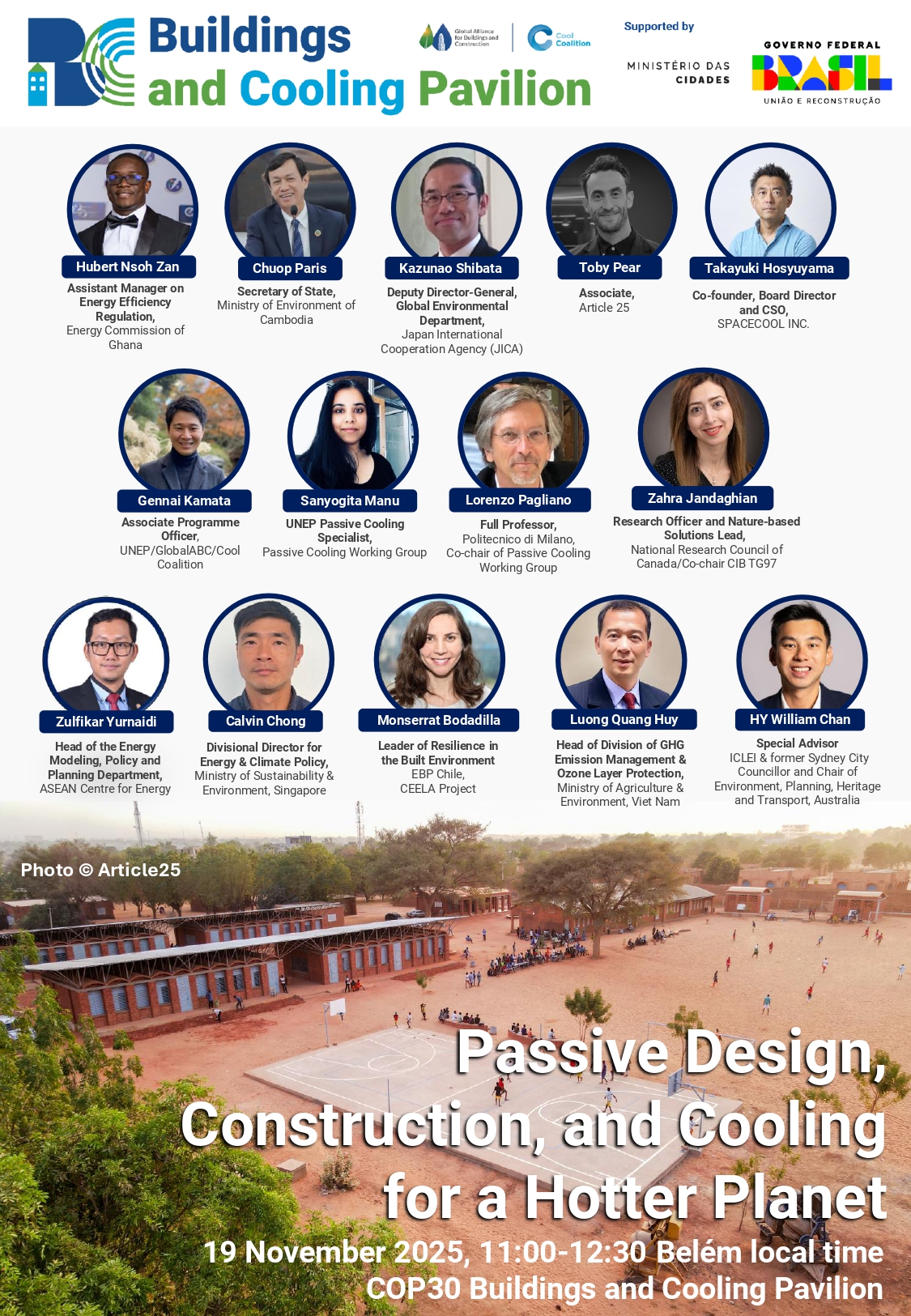
| Time | Session | Speakers |
11:00 - 11:05 | Opening | Mr. Hubert Nsoh Zan |
11:05 - 11:10 | Special Remarks | H.E. Chuop Paris, Secretary of State, Ministry of Environment of Cambodia |
11:10 - 11:15 | Keynote | Mr. Kazunao SHIBATA, Deputy Director-General, Group Director for Environmental Management and Climate Change Global Environmental Department, Japan International Cooperation Agency (JICA) |
11:15 - 11:22 | Inspirational Presentation | Mr. Toby Pear, Associate, Article 25 |
11:22 - 11:34 | Passive Cooling WG 2025 activities highlight | Mr. Gennai Kamata, UNEP/GlobalABC/Cool Coalition
Dr. Sanyogita Manu, UNEP Passive Cooling Specialist
Dr. Lorenzo Pagliano, Full Professor, Politecnico di Milano
Dr. Zahra Jandaghian, National Research Council of Canada/Co-chair CIB TG97 |
11:35 - 12:10 | Panel Discussion | Moderator: Dr. Zulfikar Yurnaidi, Head of the Energy Modeling and Policy Planning Department, ASEAN Center for Energy
Dr. Luong Quang Huy, Head of Division of GHG Emission Management and Ozone Layer Protection, Department of Climate Change, Ministry of Agriculture and Environment of Viet Nam
Ms. Monserrat Bodadilla, Co-director CEELA, Leader Resilient Infrastructure at EBP Chile
A/Prof. HY William Chan, Special Advisor, ICLEI and former Sydney City Councillor and Chair of Transport, Heritage, Environment and Planning, Australia |
12:10 - 12:25 | Q&A | Audience |
12:25 - 12:30 | Towards the Future/Closing | Mr. Takayuki Hosyuyama, Co-founder, Board director and CSO, Spacecool |


