


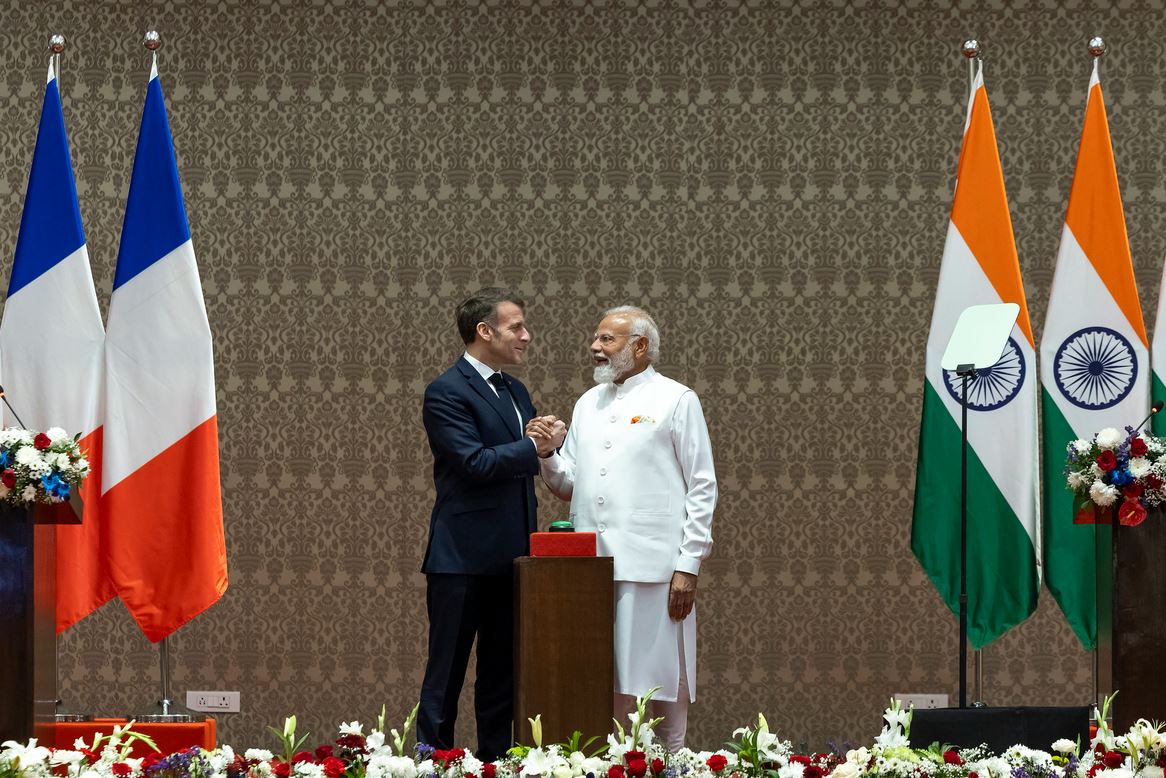
On 17 February 2026, the governments of India and France issued a Joint Statement following the official visit of President Emmanuel Macron to India at the invitation of Prime Minister Modi — an occasion that also marked the inauguration of the India-France Year of Innovation 2026 and India's hosting of the Artificial Intelligence Impact Summit.
The Statement, which covers a wide range of bilateral commitments spanning security, energy, space, digital infrastructure, climate action, and people to people exchanges, includes an explicit commitment to buildings decarbonisation. Under the section Partnership for the Planet, the two leaders affirmed that they:
"will engage for decarbonization and resilience of the buildings sector, notably through the Declaration de Chaillot and its Intergovernmental Council for Buildings and Climate and support efforts to decarbonise hard-to-abate sectors."
The Global Alliance for Buildings and Construction (GlobalABC) welcomes this commitment and the recognition it extends to the Déclaration de Chaillot and the Intergovernmental Council for Buildings and Climate (ICBC).
© Présidence de la République France
About the Intergovernmental Council for Buildings and Climate
The ICBC was established through the Déclaration de Chaillot, adopted by over 60 countries at the Buildings and Climate Global Forum in Paris in March 2024, co-organised by France and the United Nations Environment Programme (UNEP). Officially institutionalised at COP29 in November 2024, the Council has continued to grow in both membership and ambition. At COP30 in Belém in November 2025, the ICBC held its first Ministerial Meeting, bringing together ministers and senior government representatives to advance global cooperation on buildings and climate. The meeting resulted in the adoption of the Belém Call for Action for Sustainable and Affordable Housing, establishing concrete, time-bound commitments to advance climate resilience and affordability in the housing sector.
The ICBC serves as the delivery mechanism for the Chaillot Declaration, bringing together national governments to share best practices, develop policy frameworks, and coordinate action on the decarbonisation and climate resilience of the buildings sector. The Council is currently chaired by France, with Brazil and Kenya serving as Vice-Chairs.
Significance of the Commitment
India and France are among the world's most significant actors in the buildings sector. With India projected to more than double its floor area by 2050, the policy and investment choices made now will determine the emissions profile of its built environment for decades to come. France has been a consistent champion of buildings in global climate diplomacy serving as chair of the ICBC Troika, and as a founding member of the GlobalABC launched at COP21 in Paris, France.
The inclusion of the ICBC and the Déclaration de Chaillot in a bilateral heads-of-state Joint Statement reflects the growing recognition among governments that decarbonising the built environment is a shared international responsibility — and that multilateral mechanisms such as the ICBC provide an effective framework for advancing that agenda.
UNEP and GlobalABC's Work in India
This political commitment builds on concrete collaboration already under way. Through its global programmes on sustainable buildings and materials, UNEP and GlobalABC have been supporting India in developing the tools and evidence base needed to accelerate buildings decarbonisation, including:
- Development of a Climate Action Roadmap for Buildings and Construction for the State of Odisha, now guiding national climate policy and informing the enhancement of India's Nationally Determined Contributions (NDCs).
- Establishment of a Lifecycle Assessment (LCA) methodology and framework in India to measure and account for embodied carbon emissions in residential buildings.
- Demonstration projects in Maharashtra showcasing the use of low-carbon construction materials in residential redevelopment and inclusive housing, and a project of 44 green and inclusive homes in Odisha's Pragati Vihar community, demonstrating how sustainability and social inclusion can advance together.
- Development of a new CAPSA Digital Building Passport module to help construction sector stakeholders calculate and understand the carbon savings achievable through sustainable material choices, piloted in India and Ghana.
Activities are co-funded by BMZ and the SED Fund, focusing on Odisha, Maharashtra, and national-level agencies including the Bureau of Energy Efficiency (BEE) and the Building Material and Technology Promotion Council (BMTPC). These initiatives demonstrate that the ambitions reflected in the India-France Joint Statement are grounded in practical, ongoing collaboration.
Looking Ahead
GlobalABC looks forward to continued engagement with both governments and all ICBC member states as the international community advances its collective commitments on buildings and climate. The Sustainable Buildings and Construction Summit 2026 taking place in Lausanne, Switzerland, from 20–22 April 2026 will convene ICBC members for an ICBC Technical Meeting and will serve as an important opportunity to further translate political commitment into concrete national action.
GlobalABC encourages all governments committed to making near-zero emission and resilient buildings the new normal by 2030 to engage with the ICBC.
Important links
Read the full India-France Joint Statement:
- India: https://www.mea.gov.in/bilateral-documents.htm?dtl/40783/India__France_Joint_Statement_February_17_2026
- France: https://www.elysee.fr/en/emmanuel-macron/2026/02/17/india-france-joint-statement-1#moduleAnchor-259923
Learn more about the ICBC: globalabc.org/intergovernmental-council-buildings-and-climate-icbc
Learn more about the ICBC’s first ministerial meeting at COP30: globalabc.org/news/icbc-hosts-first-ministerial-cop30
Register for the Lausanne Summit: sustainable-construction.org/register/


