



New Global Insights on Financing for Sustainable Buildings
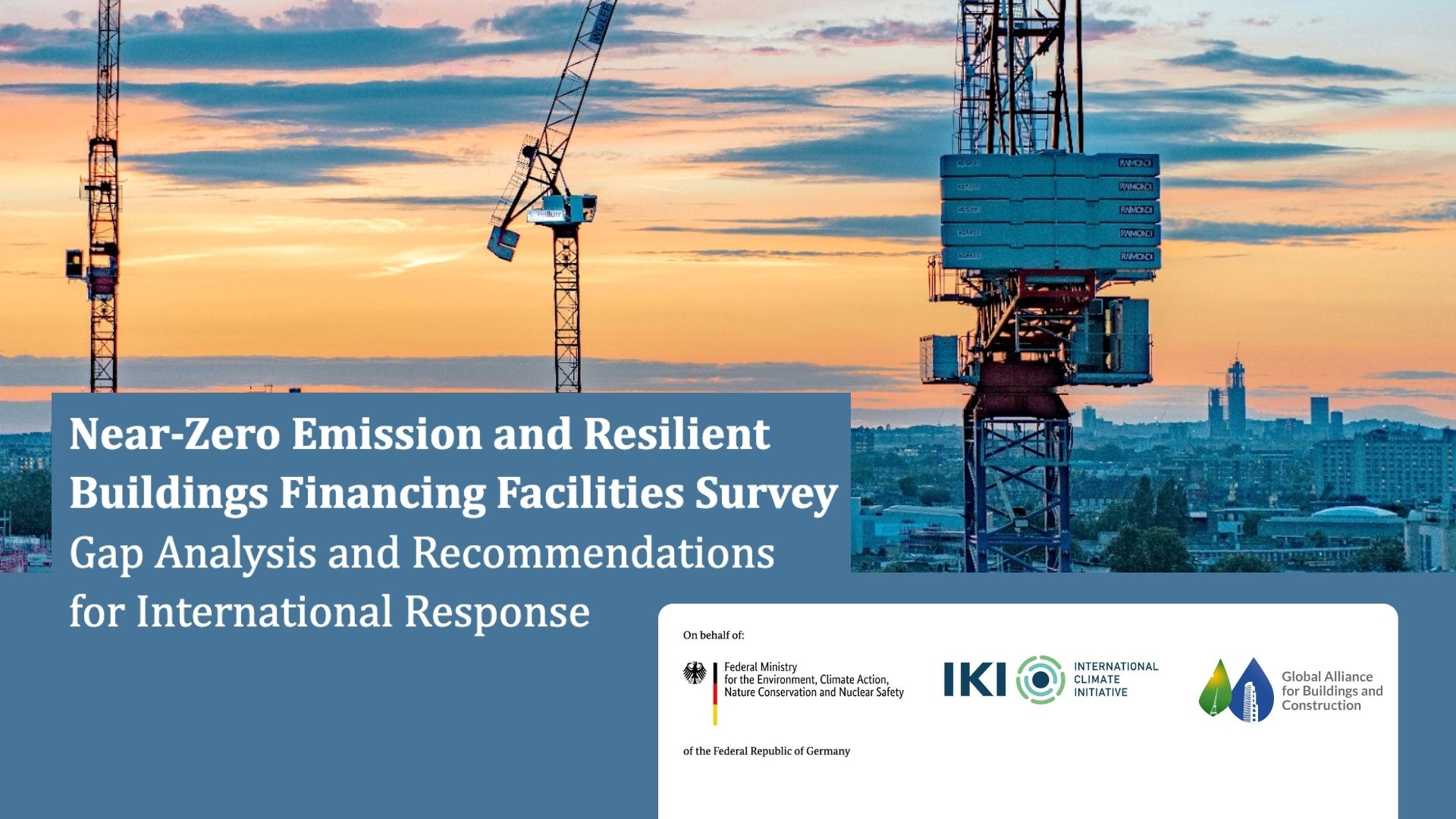
The Global Alliance for Buildings and Construction (GlobalABC) is pleased to share the newly published Near-Zero Emission and Resilient Buildings Financing Facilities Survey, a global mapping that provides a clear picture of where we stand — and what is needed to unlock investment at scale.
Why this matters
The buildings and construction sector represents approximately 37% of global energy-related carbon dioxide emissions and must be largely decarbonised by 2050. Achieving this transformation requires a massive scaling-up of investment, yet the current gap stands at a minimum of $100 billion annually. According to the IEA, global investment in the buildings sector must rise to some $5.4 trillion annually by 2050 to align with a below 2°C pathway.
What the study found
Commissioned by the German Federal Ministry for the Environment, Climate Action, Nature Conservation and Nuclear Safety (BMUKN), and developed in partnership with the UNEP-hosted GlobalABC Secretariat, the study surveyed two tiers of international financing facilities and technical assistance institutions to assess how effectively they support Near-Zero Emissions and Resilient Buildings (NZERB) investment.
The analysis reveals a fragmented and reactive financing landscape. Except for a few dedicated facilities, NZERB projects represent a very small portion of the portfolios of large financing institutions, which generally lack specific frameworks for supporting them. The dominant financing instruments used were grants (87% of facilities) and loans (41% of facilities) — yet guarantees and subordinated debt, which are more scalable instruments that can crowd in private capital, are largely absent. Learn more about the Near-Zero Emission and Resilient Buildings Financing Facilities Survey here
Three critical gaps were identified
• Strategic and knowledge gaps: A lack of strategic focus within major institutions, reinforced by poor data and the absence of standardised definitions, metrics, and monitoring for NZERB.
• Institutional and actor gaps: No central coordinating body to guide the NZERB ecosystem, coupled with limited access for the private sector and low engagement from International Financial Institutions (IFIs) due to high transaction costs.
• Financial and pipeline gaps: A reliance on inadequate financial instruments that fail to scale investment, a weak project pipeline, and a bias toward energy projects with clear financial returns over those with non-monetised resilience benefits.
The way forward
The message is clear: the challenge is not only mobilising more capital, but better structuring, coordinating, and channelling it towards impactful building projects. The study proposes an integrated framework built on three pillars:
• Pillar 1: Standardised NZERB criteria and investment mechanisms
• Pillar 2: Viable and locally adapted business models
• Pillar 3: Local capacity for implementation and financing
Key recommendations include fostering alignment between green building standards and climate finance taxonomies, de-risking investment through guarantees and blended finance, building local capacity within regulatory bodies and financial institutions, and strengthening institutional coordination to build a robust ecosystem for NZERB investment.
By mapping the current financing landscape, the survey helps bridge the gap between global finance availability and national implementation, supporting countries to scale investment and accelerate the transition to zero-emission and resilient buildings.
Download and read the Near-Zero Emission and Resilient Buildings Financing Facilities Survey here.


