2023-07-21

The construction industry’s inherent fragmentation fuels Construction Supply Chain (CSC) complexity. Logistics form an essential part of the CSC in terms of costs and project management. In turn, transportation accounts for more than half the logistics costs due to construction materials being low-cost/high-volume, and most other logistics processes being business processes and not physical ones.

2023-07-21

Construction logistics offer useful solutions to improve both the productivity and sustainability of the industry. The purpose of this paper is to investigate, in detail, the environmental impact of construction transport and whether the building certification scheme for a construction project has any influence on its transport arrangements. The analysis in this paper is based on a multiple case study of 40 Swedish projects.

2023-07-21

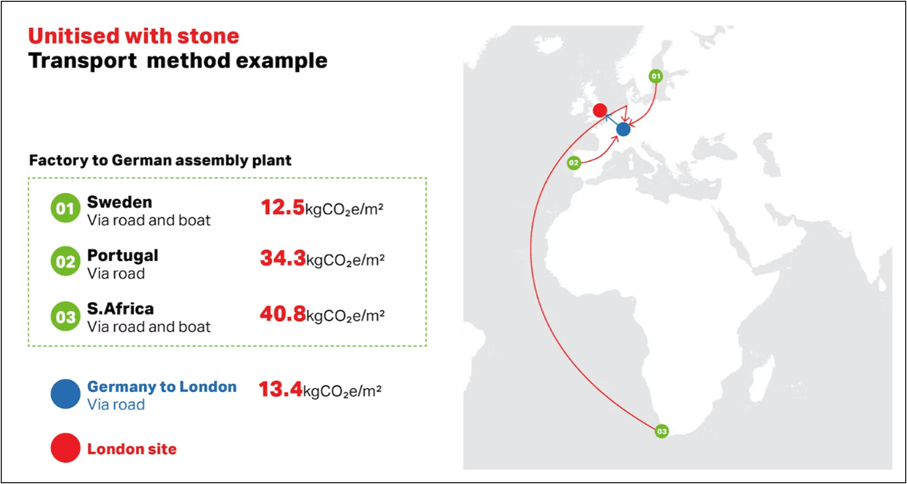
The design and production of the facade system can have a significant effect on the embodied carbon of a building.

The transportation of facade materials and components to a factory, between factories, and to the building site can also have a big impact. Understanding this impact is important in determining the optimum design and specification for a low-carbon building.

Author: Make Architects

2023-07-21

In Germany, according to the "Kreislaufwirfschaft Bau", 14.6 million tonnes of construction site waste were generated in 2014.  In a position paper, Glass for Europe estimate that float glass accounts for less than 1% of construction site waste.  Even this apparently small amount is not negligible as glass is predestined for closed-loop recycling.  The use of glass cullet not only conserves natural raw material resources, but also reduces the melting energy required, and thus, also the CO2 emissions.

2023-07-21

The environmental consequences of plastic solid waste are visible in the ever-increasing levels of global plastic pollution both on land and in the oceans. But although there are important economic and environmental incentives for plastics recycling, end-of-life treatment options for plastic solid waste are in practice quite limited.

Presorting of plastics before recycling is costly and time-intensive, recycling requires large amounts of energy and often leads to low-quality polymers, and current technologies cannot be applied to many polymeric materials.

2023-07-21

Given increasing concerns for the marine environment and human health, as well as trade restrictions from Asian countries, plastics have become a great challenge for the United States.

This study addresses the seven commonly used plastics: low-density polyethylene/linear low-density polyethylene, high-density polyethylene, polyethylene terephthalate (PET), polypropylene, polystyrene, polyvinyl chloride, and other plastics.

2023-07-21

Demand for aluminum in final products has increased 30-fold since 1950 to 45 million tonnes per year, with forecasts predicting this exceptional growth to continue so that demand will reach 2–3 times today’s levels by 2050. Aluminum production uses 3.5% of global electricity and causes 1% of global CO2 emissions, while meeting a 50% cut in emissions by 2050 against growing demand would require at least a 75% reduction in CO2 emissions per tonne of aluminum produced—a challenging prospect.

2023-07-21

Over the past four decades, global plastics production has quadrupled. If this trend were to continue, the GHG emissions from plastics would reach 15% of the global carbon budget by 2050. Strategies to mitigate the life-cycle GHG emissions of plastics, however, have not been evaluated on a global scale.

2023-07-21

Renewable and biodegradable materials derived from biomass are attractive candidates to replace non-biodegradable petrochemical plastics. However, the mechanical performance and wet stability of biomass are generally insufficient for practical applications.

2023-07-21

The temperature of cities continues to increase because of the heat island phenomenon and the undeniable climatic change. The observed high ambient temperatures intensify the energy problem of cities, deteriorates comfort conditions, put in danger the vulnerable population and amplify the pollution problems.