2022-12-09

The MIT Concrete Sustainability Hub (CSHub) is a dedicated interdisciplinary team of researchers from several departments across MIT working on concrete and infrastructure science, engineering, and economics since 2009. The MIT CSHub brings together leaders from academia, industry, and government to develop breakthroughs using a holistic approach that will achieve durable and sustainable homes, buildings, and infrastructure in ever more demanding environments. Resources in the CSHub are largely focused upon the USA context, but are internationally applicable. 

2022-12-09

China is the world’s largest producer and consumer of cement. The industry accounts for 13 percent of the country’s total carbon emissions, making it the third largest-emitting industry after power and steel.

2022-12-06

In Senegal, the construction sector is booming. Today, concrete is used widely in construction sites but although it is produced locally and inexpensively, it is highly polluting. However, architects such as Worofila Architecture want to build differently, inspired by the raw earth houses of yesteryear and bringing local know-how back to life. These methods can greatly reduce the impacts of concrete building, whilst producing attractive buildings with excellent thermal performance.

2022-12-06

Cement is responsible for 7% of global greenhouse gas emissions, and is predicted to grow with increasing development. The majority is used in concrete, globally the most common material in buildings. Reducing emissions from the use of cement and concrete in buildings is therefore critical in order to limit global warming. However there remain multiple gaps in knowledge about the extent of these emissions.

2008-01-01

For seventy-five years, Architectural Graphic Standards has been the go-to reference for architects, builders, and engineers. Revised for the first time since 2000, Architectural Graphic Standards Student Edition is an entirely new, definitive reference work for everyone involved with lands.

2021-08-01

User-friendly overview of proven and scalable solutions to reduce concrete’s contribution to climate change. This guide highlights six key opportunities to reduce embodied carbon in concrete products without compromising financial or material performance.

2021-09-01

Policy brief paper analysing the policy, legal and regulatory frameworks governing the cement sector in Nigeria, Africa, and examines the policies required to encourage increased use of bioenergy in cement production.

2018-03-13

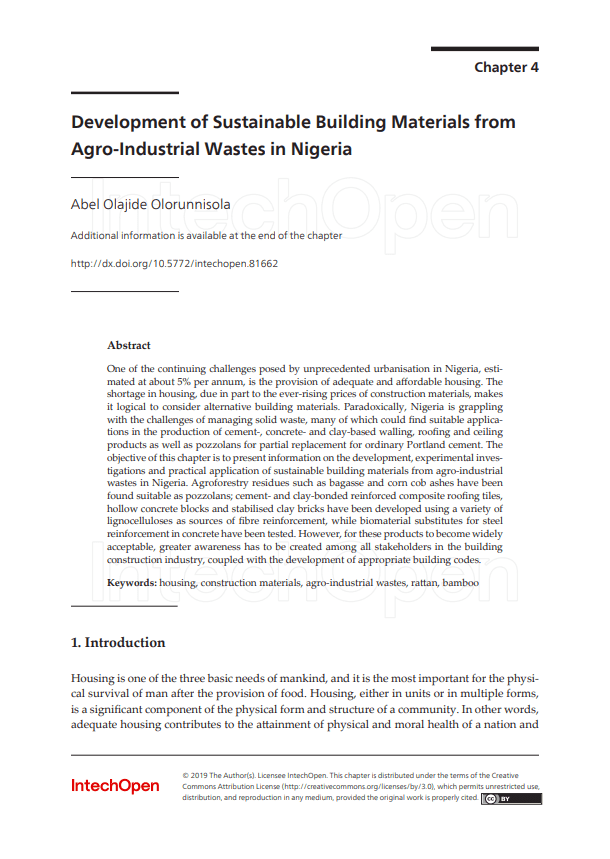
Policy brief presenting information on the development, experimental investigations and practical application of sustainable building materials from agro-industrial wastes in Nigeria, Africa.

2021-09-01

Study into the key aspects of international best practices of green public procurement policies that can be adopted in the USA for successful design and implementation of the Federal Buy Clean initiative. The Buy Clean initiative calls for the prioritisation of American-made, lower-carbon construction materials in federal procurement and federally assisted projects in North America.