2017-03-01

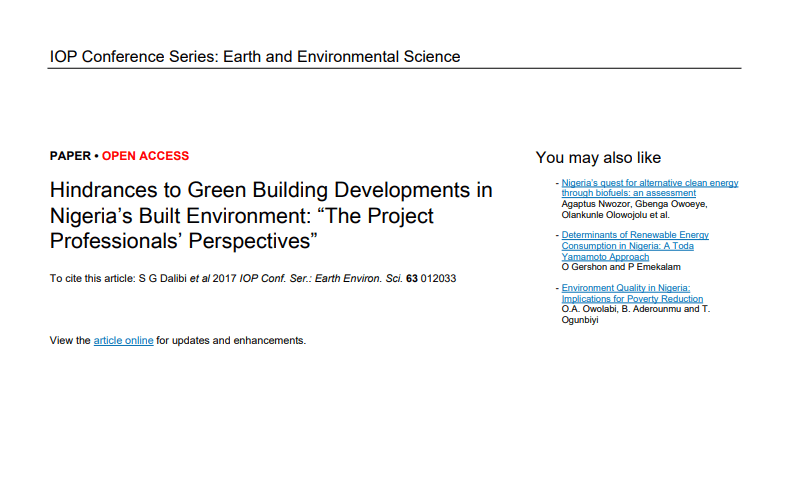
Research paper that aims to identify, examine and assess the factors that are hindering green building developments in Africa based on the project professionals' perceptions. A qualitative review of literature is used to identify the various factors that hinder the adoption of green measures and practices within Nigeria's built environment.

2022-05-01

This paper describes how, when substituted for concrete and steel, mass timber is a carbon-absorbing, energy-efficient, lower-cost, durable and mendable building material that can help deliver affordable urban housing and rural livelihood opportunities. It is suitable for Africa, where trees grow faster than in temperate climates. Africa can mitigate climate change and achieve other developmental benefits using mass timber in its construction sector. Governments and other development actors can support the transition.

2021-09-01

Study into the key aspects of international best practices of green public procurement policies that can be adopted in the USA for successful design and implementation of the Federal Buy Clean initiative. The Buy Clean initiative calls for the prioritisation of American-made, lower-carbon construction materials in federal procurement and federally assisted projects in North America.


2022-11-28

Design and construction teams have a growing number of strategies and tools to choose from to reduce embodied carbon in their projects. This template, found here, provides a checklist for project teams in North America (USA) to use and adapt. The template makes it easier for teams to systematically discuss if they have considered strategies that may be relevant to their projects.

2022-11-28

The Carbon Leadership Forum has created a Carbon Policy Toolkit, found here— an array of resources to support the crafting of policies to radically reduce embodied carbon in North America, the USA, and beyond. 

2022-11-28

The Embodied Carbon in Construction Calculator (EC3) tool is a free and easy-to-use tool that allows benchmarking, assessment and reductions in embodied carbon, focused on the upfront supply chain emissions of construction materials.