2023-07-26

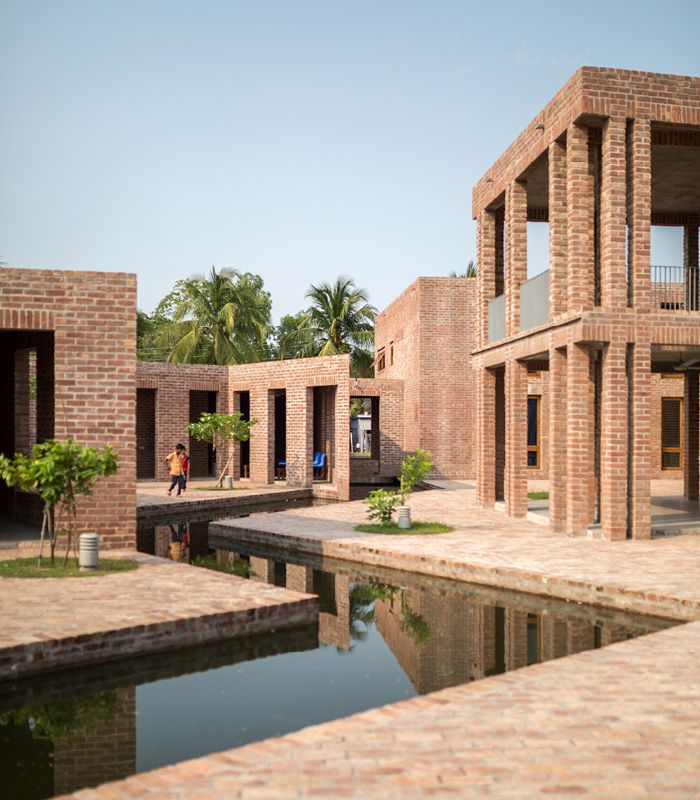
The Friendship Hospital Satkhira, designed by Kasef Chowdhury/URBANA, is built to serve a rural population in the Bangladesh delta. The community hospital of eighty beds was initiated by a donation of land by a local philanthropist.

The construction in bricks built in situ celebrates this ordinary material without having to resort to complex technology leading to increased budgets. Local materials by local craftmanship helps the integration of the building to the native culture and society.

This project won the RIBA International Prize 2021

2023-07-26

Construction commenced on this project in 2006, and it was officially opened in 2009, taking a total of 42 months to complete. The concrete piers of this iconic bridge were constructed using 50% Ecocem GGBS, saving thousands of tonnes of CO2 and greatly increasing the bridge's lifespan.

2023-07-26

Because public entities exercise large-scale purchasing power in contracts for goods, services, and construction of infrastructure, policies prioritizing environmentally and socially responsible purchasing can drive markets in the direction of sustainability. In fact, public procurement accounts for an average of 12 percent of GDP in OECD countries, and up to 30 percent of GDP in many developing countries.

2023-07-26

As the need to stem climate change gains in urgency virtually by the day, new environmentally sensitive practices and policies targeted at limiting the global average temperature increase to 1.5°C above pre-industrial levels are essential. This is particularly relevant in the manufacturing of cement – the key ingredient in concrete. The world is in the midst of an infrastructure and building boom as new economies emerge and developed economies expand.

2023-07-21

The construction industry’s inherent fragmentation fuels Construction Supply Chain (CSC) complexity. Logistics form an essential part of the CSC in terms of costs and project management. In turn, transportation accounts for more than half the logistics costs due to construction materials being low-cost/high-volume, and most other logistics processes being business processes and not physical ones.

2023-07-21

Construction logistics offer useful solutions to improve both the productivity and sustainability of the industry. The purpose of this paper is to investigate, in detail, the environmental impact of construction transport and whether the building certification scheme for a construction project has any influence on its transport arrangements. The analysis in this paper is based on a multiple case study of 40 Swedish projects.

2023-07-21

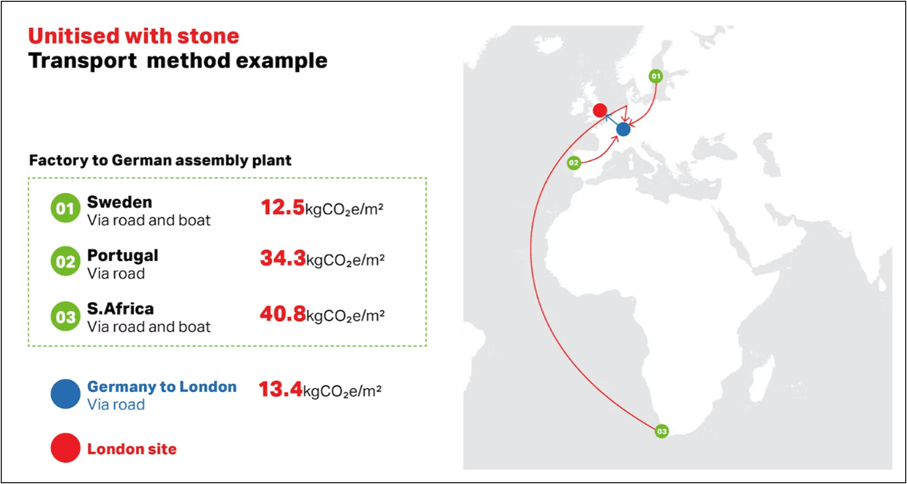
The design and production of the facade system can have a significant effect on the embodied carbon of a building.

The transportation of facade materials and components to a factory, between factories, and to the building site can also have a big impact. Understanding this impact is important in determining the optimum design and specification for a low-carbon building.

Author: Make Architects

2023-07-21

The transition to a carbon neutral EU requires deep energy demand reductions in key sectors of the economy such as buildings and transport, and that the remaining energy consumed is carbon neutral. Such transformations can only be achieved if the conditions are created for all actors and industrial sectors to maximise their multi-faceted contributions to this low-carbon revolution.

2023-07-21

Demand for aluminum in final products has increased 30-fold since 1950 to 45 million tonnes per year, with forecasts predicting this exceptional growth to continue so that demand will reach 2–3 times today’s levels by 2050. Aluminum production uses 3.5% of global electricity and causes 1% of global CO2 emissions, while meeting a 50% cut in emissions by 2050 against growing demand would require at least a 75% reduction in CO2 emissions per tonne of aluminum produced—a challenging prospect.

2023-07-21

Over the past four decades, global plastics production has quadrupled. If this trend were to continue, the GHG emissions from plastics would reach 15% of the global carbon budget by 2050. Strategies to mitigate the life-cycle GHG emissions of plastics, however, have not been evaluated on a global scale.