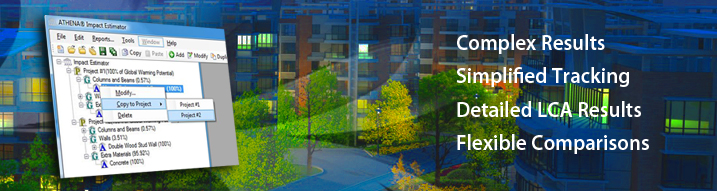
In North America, the Athena Impact Estimator for Buildings is the only free software tool that is designed to evaluate whole buildings and assemblies based on internationally recognized life cycle assessment (LCA) methodology.
WUFI - Oak Ridge National Laboratory (ORNL)/Fraunhofer IBP is a menu-driven PC program which allows realistic calculation of the transient coupled one-dimensional heat and moisture transport in multi-layer building components exposed to natural weather. It is based on the newest findings regarding vapor diffusion and liquid transport in building materials and has been validated by detailed comparison with measurements obtained in the laboratory and on outdoor testing fields.
Provided by the N.C. Clean Energy Technology Center, DSIRE is a database of incentives and policies to support renewables and energy efficiency in the United States.
NREL's PVWatts® Calculator Estimates the energy production of grid-connected photovoltaic (PV) energy systems throughout the world. It allows homeowners, small building owners, installers and manufacturers to easily develop estimates of the performance of potential PV installations.
The Sefaira tool uses industry-accredited analysis engines for modelling and comparison of different building designs. This enables a fast performance assessment across a range of metrics - energy use and carbon emissions, thermal comfort, daylight and HVAC.
Insight is a tool aimed at architects and engineers to support design of more energy-efficient buildings, using advanced simulation engines, and integration with Revit.
The Building Energy Modeling (BEM) sub-program is an important part of BTO and its Emerging Technologies Program. BEM is a versatile, multipurpose tool that is used in new building and retrofit design, code compliance, green certification, qualification for tax credits and utility incentives, and even real-time building control.
Architecture 2030 developed the Zero Tool for building sector professionals, 2030 Challenge and 2030 Commitment adopters, 2030 District Network Members, and policymakers.
EnergyPlus™ is a whole building energy simulation program that engineers, architects, and researchers use to model both energy consumption—for heating, cooling, ventilation, lighting and plug and process loads—and water use in buildings.
Value-based decision making is already in use in both government and private sector investment policy. A complementary new Flex Standard is now available for FREE download that describes the process of making and implementing value-based decisions in the built environment to drive better social, environmental and economic outcomes.