Material
|
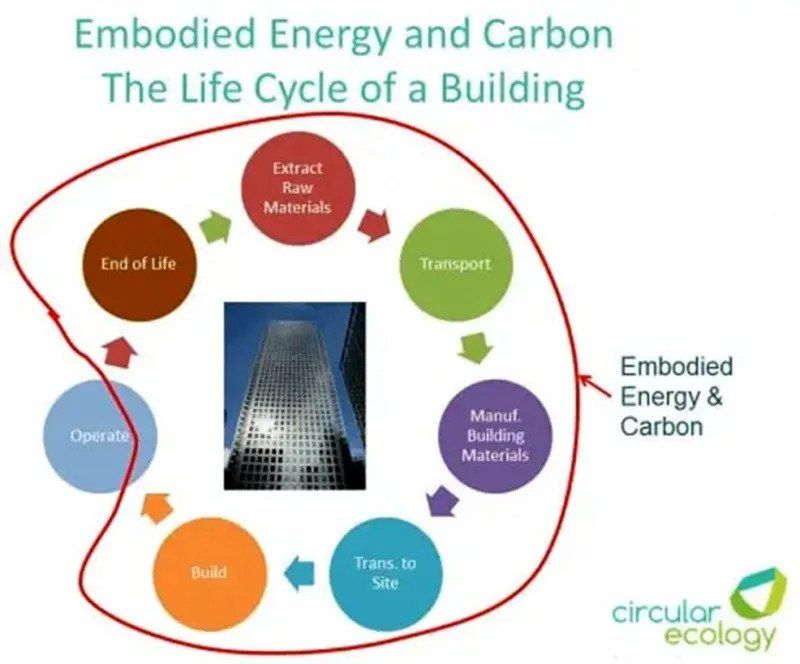
The buildings sector currently contributes 37% of global energy and processes CO2 emissions. Approximately three-quarters of these emissions come from the operational carbon produced during the use of buildings, while the other quarter is attributed to the embodied carbon in building materials like cement, steel, and aluminum. Policymakers have traditionally focused on reducing operational energy use in buildings, but there is a growing awareness of the urgent need to address embodied carbon in materials. Certain non-renewable building materials such as cement & concrete, steel, aluminum, plastics, and glass have the highest embodied carbon, while earth-based materials have a lower impact and bio-based materials like timber, bamboo, agricultural wastes, and biomass have the lowest impact, as long as they are harvested and processed sustainably. Whilst a holistic approach based on lifecycle thinking is key to reducing the environmental burdens of building materials, addressing individual, higher priority materials can also have a significant impact - both at the individual building level, or as part of policy. For example, in recent years we have seen the first examples of policies that set limits on the embodied carbon of commonly used, high impact materials such as cement, steel and aluminium, such as the Buy Clean California legislation or the EU Taxonomy. The choice of building materials affects operational carbon and influences other climate change effects like creating urban heat islands. Below is a summary of decarbonisation strategies of the most common existing building and construction materials: |

|
Non-renewable materials
- Concrete
-
- Improve quarry rehabilitation and biodiversity restoration of landscapes.
- Reduce the clinker-to-cement ratio with alternative materials.
- Use recycled aggregates.
- Electrify kilns and use renewable electricity sources.
- Integrate carbon capture and storage to provide additional strength.
- Minimize waste with computational design-for-disassembly and re-use.
- Minimize on-site waste and emissions through pre-fabrication.
- Educate building design professionals in material efficiency, optimization.
- Develop standards and building codes that require modular concrete.
- Incentivize renovation over demolition and building codes for recycled.
- Steel
-
- Shift from blast furnaces to direct reduced iron (DRI) technology.
- Electrify all steel production methods with renewable energy sources.
- Reduce steel use through a combination of material efficiency measures.
- Avoid using new steel by substituting re-used (best) and recycled materials.
- Shift to low-carbon alternatives such as bio-based materials if possible.
- Adapt building codes to avoid overspecification and optimize structures.
- Design with pre-fabricated elements for disassembly and re-use.
- Include material efficiency training in the curricula of architects and engineers.
- Ensure that stakeholders across the value chain use the same metrics.
- Improve recycling methods to enable the recovery and use of more steel.
- Aluminium
-
- Reduce production of new aluminium by promoting re-use and recycling.
- Use electricity from renewable sources (including hydropower).
- Impose strict regulations to design for the circularity of component parts.
- Standardize aluminum alloys/components for re-use.
- Avoid overspecification and use of primary source material.
- Electrify heavy construction and transport equipment.
- Specify high-performance building envelopes.
- Maximize recycling and invest in alloy-specific sorting and recycling.
- Certify disassembled and re-used components.
- Plastic
-
- Avoid the production of non-recyclable products that harm the biosphere.
- Reduce the use of plastics in building materials, where feasible.
- Use bio-based plastics and feedstocks produced with renewable energy.
- Design for disassembly and re-use.
- Standardize the chemical compositions of polymers for ease of recycling.
- Increase transparency and/or standardize chemical compositions.
- Trace material usage to keep track of available stock.
- Increase material life with low-carbon maintenance practices.
- Invest in much greater recycling to avoid production of new plastics by improving collection, sorting, chemical and mechanical recycling.
- Glass
-
- Avoid new demand by extending lifetimes of buildings and components.
- Incentivize and support locally produced and recycled glass sources.
- Improve research on efficient melting techniques to avoid emissions.
- Shift glass production to best available technologies and recycling.
- Electrify production, construction, and transport with renewable energy.
- Use process intensification and waste heat recovery.
- Design standard components and façade surfacing for recycling, re-use.
- Design glass façades that minimize heat absorption and reflection and instead capture solar energy for heating, cooling, water and lighting.
Transitional materials
- Masonry
-
- Regulate quarry closure to restore natural landscapes.
- Use structural and facing brick to increase longevity and reduce maintenance.
- Replace high-carbon cement binders with lower-carbon alternative binders.
- Use cement/mortar alternatives, such as fly ash waste and sewage sludge ash.
- Design masonry units for disassembly and re-use.
- Incentivize local, low-carbon brick making.
- Educate design professionals in methods to enhance the longevity of non-stabilized earth masonry.
- Incentivize renovation over demolition.
Renewable materials
- Timber and Wood
-
- Incentivize forestlands owners to develop sustainable management.
- Improve the design of forest byproducts, to improve circularity in timber.
- Improve collection rates of “clear-cuts” from logging practices and off-cuts from wood manufacturing for wood products.
- Improve wood manufacturing to capture loss from timber processing.
- Promote and incentivize the use and re-use of structural mass timber.
- Train and upskill construction actors in design-for-disassembly wood.
- Update building codes to mandate reliably certified products.
- Incentivize the research and development of non-toxic glues and binders.
- Bamboo
-
- Increase policy support for commercial enterprises transitioning to highly productive and sustainable bamboo forest management.
- Improve bamboo plant propagation methods.
- Transition bamboo manufacturing to on-site renewable energy.
- Promote material efficiency by developing structural standards for different regional species and circular design.
- Incentivize the use of non-toxic chemicals and glues.
- Integrate and/or adapt bamboo standards for local building codes.
- Educate architecture, engineering and construction professionals.
- Biomass
-
- Integrate intersectoral biomass supply chain management.
- Incentivize and invest in technologies and bioadhesives.
- Redirect biomass towards higher-value end-of-use products.
- Create financial incentives for the capture of biomass building materials.
- Educate and train built environment professionals in design.
- Educate stakeholders on effective maintenance of products.
- Educate finance and insurance companies to incentivize adoption.
- Implement marketing and education programmes.
- Train and upskill material recovery management to improve re-use rates.
- Living materials
-
- Understand native ecological systems and context before introducing new living biomass material; Use native species and organic fertilizer.
- Adapt district-scale carbon incentives for impacts to urban heat island and stormwater infrastructure.
- Design with low-carbon material substructures, growing media, passive solar energy, and harvested rainwater for irrigation.
- Provide avenues for circular compost and waste by-product recovery.
- Minimize material use through the optimization of structures.
- Minimize weight of materials by using less water and soil.