2022-12-09

Background: Climate change action is time critical. There is an immediate need to focus policy and market actions on emission reductions across the entire life cycle of buildings as these are very quickly using up the remaining carbon budget left before the tipping point of an irreversible climate crisis. This provides a compelling reason for policymakers to address all sources of carbon emissions from the buildings and construction sector, including both embodied and operational carbon – together referred to as “whole-life” carbon (WLC) emissions.

2022-12-09

This volume on the building and construction sector provides an overview of the different sources of GHG emissions from the building and construction sector, as well as methodologies for quantifying these emissions to feed into the preparation and reporting of national GHG inventories. By better understanding the sources of emissions over the whole life cycle of buildings, it thus provides guidance on the most appropriate and effective mitigation strategies and policies for decarbonizing the building and construction sector based on national circumstances.

2022-12-09

Building construction materials represent 11% of global carbon emissions and 28% of the annual buildings related CO2 emissions, and yet, the demand for construction materials continues to grow, especially in the rapidly urbanizing Global South. Biomaterials offer a key opportunity for decarbonizing the buildings and construction sector, through transitioning from current linear, extractive, and toxic construction practices towards circular, bio-based, renewable materials and construction methods for a sustainable future.

2022-12-09

UN Secretary-General calls latest IPCC WG1 Climate Report a ‘Code Red for Humanity’, stressing ‘irrefutable’ evidence of human influence, and that “climate impacts will undoubtedly worsen”.

2022-12-09

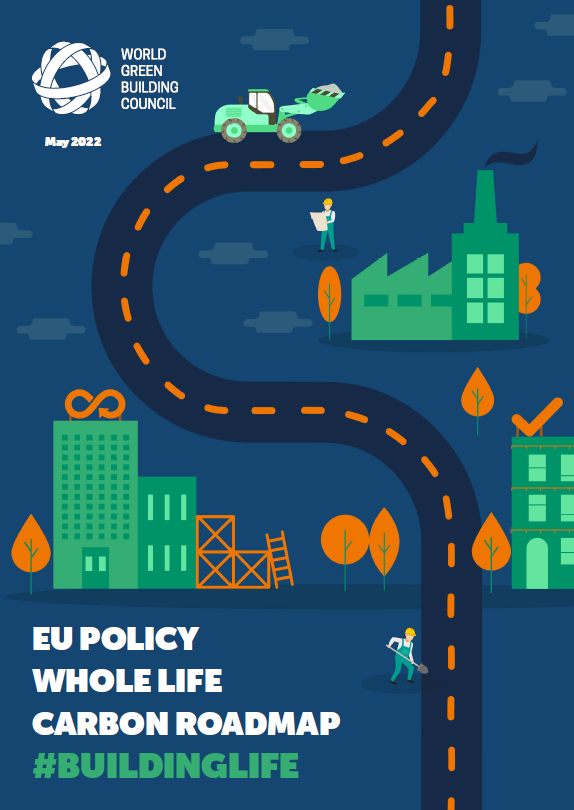
On 24 May 2022, WorldGBC launched the EU Policy Whole Life Carbon Roadmap for buildings as part of the #BuildingLife project.  This Roadmap outlines the key European Union (EU) policy interventions, regulatory measures and tools needed to achieve a decarbonised, circular, resilient and well-designed built environment by 2050. It focuses on measures to address whole life carbon (WLC) at the building level.

Created as part of the #BuildingLife project, this Roadmap provides:

2022-12-09

This document was elaborated by the Carbon Neutral Cities Alliance (CNCA) and Culmer Raphael under the project "Dramatically Reducing Embodied Carbon in Europe's Built Environment", which CNCA launched in 2021 with the support of the Laudes Foundation. The purpose of this document is to serve as a communications material that city staff can resort to when raising awareness of the importance of addressing embodied carbon and increasing the uptake of bio-based materials among their city-department peers.

2022-12-09

China is the world’s largest producer and consumer of cement. The industry accounts for 13 percent of the country’s total carbon emissions, making it the third largest-emitting industry after power and steel.

2022-12-09

In this report, RMI provides a roadmap for how the US federal government can reduce embodied carbon emissions from public building projects over the next 30 years and outlines strategies for agencies to facilitate the broader movement to decarbonize the building industry and industrial supply chains. The core strategies underpinning the roadmap to zero embodied carbon by 2050 are:

2022-12-09

The Global Status Report for Buildings and Construction (Buildings-GSR) is a flagship publication of the UNEP-hosted Global Alliance for Buildings and Construction (GlobalABC). The Buildings-GSR provides an annual snapshot of the progress of the buildings and construction sector on a global scale and reviews the status of policies, finance, technologies, and solutions to monitor whether the sector is aligned with the Paris Agreement goals. It also provides stakeholders with evidence to persuade policymakers and the overall buildings and construction community to take action.

2022-12-09

This report - Sri Lanka Roadmap for Sustainable Housing and Construction 2020 – 2050 - presents the findings of the Sustainable Building Construction Country Assessment for Sri Lanka (SBC-CA) and a Roadmap for Sustainable Housing and Construction and achieving NDCs in the construction industry in Sri Lanka. It examines the current status, and potential opportunities and challenges for adopting Sustainable Building Construction (SBC) practices and policies.