2022-12-10

The urgency around climate change is pressing us to rethink our approach to delivering and using energy in buildings and how this relates to greenhouse gas (GHG) emissions.  This guide provides key information about building decarbonization, aimed at the non-technical audience. 

2022-12-10

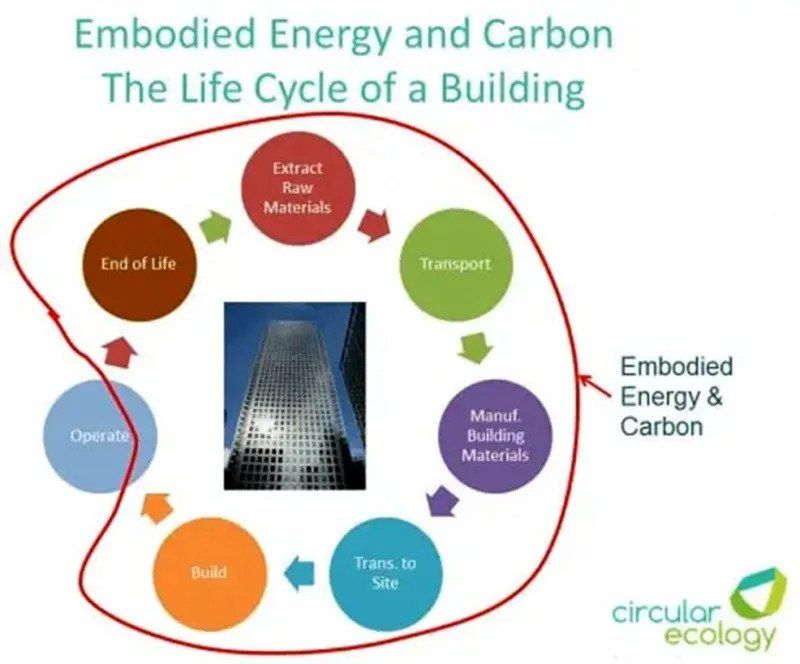
Buildings account for at least 39 percent of energy-related global carbon emissions on an annual basis. At least one-quarter of these emissions result from embodied carbon, or the greenhouse gas (GHG) emissions associated with manufacturing, transportation, installation, maintenance, and disposal of building materials.

2021-06-25

With the ÖKOBAUDAT platform, the Federal Ministry for Housing, Urban Development and Building (BMWSB) Germany provides all stakeholders with a standardized database for the life cycle assessment of buildings. At the heart of the platform is the online database with life cycle assessment data on building materials, construction, transport, energy and disposal processes. With the help of life cycle assessment tools, such as the eLCA provided by the BBSR, the entire life cycle of a building can be compiled with the ÖKOBAUDAT database.

2022-12-09

The Transition Pathway Initiative Global Climate Transition Centre (TPI Centre) is an independent, authoritative source of research and data into the progress being made by the financial and corporate world in making the transition to a low-carbon economy.

1998-01-01

The International EPD System is the world’s first and longest operational Environmental Product Declaration (EPD) programme, originally founded in 1998 as the Swedish EPD System by the Swedish Environmental Protection Agency (SEPA) and industry.

2019-11-10

The Inventory of Carbon and Energy (also know as the ICE database) is an embodied carbon database for building materials which is available for free on this page. It contains data for over 200 materials, broken down into over 30 main material categories. The first version was released in 2005 and it has been updated at periodic intervals. 

2019-01-01

The Construction Material Pyramid from CINARK at the Royal Danish Academy makes it possible to compare, for example, CO2 footprints between different categories of materials or between material types within the same category. It also makes it possible to view different kinds of environmental impacts across the different materials. It thus offers a tangible, interactive calculation tool and at the same time opens up a dialogue about more detailed studies of the materials’ position in the pyramid and later their place in the project design.

2022-12-09

The built environment is responsible for almost 40% of the global energy and process-related CO2 emissions. To meet the Paris Agreement and limit global warming to 1.5°C, we need to reach net-zero emissions across all activities in the building and construction system. The goal is for all new buildings to operate at net-zero emissions by 2030 at the latest, and for all buildings to operate at net zero by 2050.

2022-12-09

This report looks in detail at the results of six whole life cycle assessment (WLCA) case studies to illustrate some of the challenges, barriers and opportunities relating to the building industry’s carbon footprint. It aims to provide an insight into the industry’s current performance and compare it to possible net-zero trajectories.

Analyzing the whole life carbon emissions of six building projects using the WBCSD Building System Carbon Framework, the report shows that:

2022-12-09

A large part of the construction sector’s emissions come from building products and materials – referred to as embodied carbon. Embodied carbon is increasingly becoming the focus of regulatory bodies, making it a risk factor for developers and investors to price into construction projects.