Photo showing palm trees by alevision.co, via Unsplash

Climate

It is vital to ensure that the selection of building materials is appropriate for the climate in which they are used. Material performance can strongly vary, depending on the conditions to which buildings are exposed. For example, some structural materials have more appropriate thermal properties for hot or tropical climates than others, enabling better heat retention or cooling when these properties are needed. Earth based construction is not a new strategy, but one that has fallen out of favour in the last century as preferences for materials such as concrete and steel grew.  Beyond being a more appropriate material choice in some contexts, earth construction can reduce the need for brick firing or production of synthetic binders and additives, reducing fuel and material consumption, as well as reducing health risks from air emissions and chemical use.

However, a material with improved sustainability performance in one region may not provide the same in-use performance in another, and a whole lifecycle thinking approach can help ensure that material choices are optimal. Additionally, sustainability hotspots can vary between regions. For example, there may be increased impacts from extraction in one region that are not experienced elsewhere, and from increased transportation distances. The expertise of installers with a material, ability of the local supply chain to meet demand and ensure quality, and the availability of infrastructure for end-of-life processing all bear consideration when determining if a material is appropriate for a particular climate.

6
Source: United Nations Environment Programme (2023). Building Materials and the Climate: Constructing a New Future. Nairobi

However, in some cases, learnings from material selection and market development can be transferred from one region to another where there are similarities in the climate. The Hub uses the Köppen-Geiger classification, which categorises regions as Tropical, Dry, and Temperate, according to the map below. Resources that apply to a particular climate are organised accordingly.

Map of Köppen-Geiger climate classification

map


Note: Tropical (A - regions Af, Am, Aw), Dry, (B - regions BWh, BWk, BSh, BSk) and Temperate (C - regions Csa, CSb) are used in the Sustainable Building Materials Hub to categorise resources where climate considerations apply.
Source: Beck, H.E., Zimmermann, N. E., McVicar, T. R., Vergopolan, N., Berg, A., & Wood, E. F., CC BY-SA 4.0 <https://creativecommons.org/licenses/by-sa/4.0>, via Wikimedia Commons
Filters +
View results
2023-08-22

This document has been prepared by Cairns Regional Council to assist in meeting the requirements of the Sustainable Building Design Policy when designing, constructing and renovating Council buildings. These guidelines are also intended as a general reference guide for sustainable design and construction of commercial buildings in the tropics.

2023-08-22

EDGE (“Excellence in Design for Greater Efficiencies”) is a free software, a green building standard, and an international green building certification system, enabling users to design and certify resource-efficient and zero carbon buildings. 

2023-08-21

OpenLCA is an open source and free software for Sustainability and Life Cycle Assessment, with the following features:

2023-08-21

Manufacturers voluntarily disclose product information on easy-to-read Declare labels. These labels report all product ingredients and use a simple color code system to flag chemicals of concern. Further information is provided on the product’s final assembly locations, life expectancy, end-of-life options, and overall compliance with relevant requirements of the Living Building Challenge (LBC).

2023-08-21

The Global LCA Data Access network (GLAD) is the largest directory of Life Cycle Assessment (LCA) datasets, from independent LCA database providers, from around the world.

2023-08-21

Constructing new buildings and sites with the least possible environmental impact involves three important steps: reduce, renew and offset. Offsetting means calculating the project's carbon footprint so it can be balanced by funding resources or activities like renewable energy and land protection — resources that benefit and protect the planet.

2023-08-21


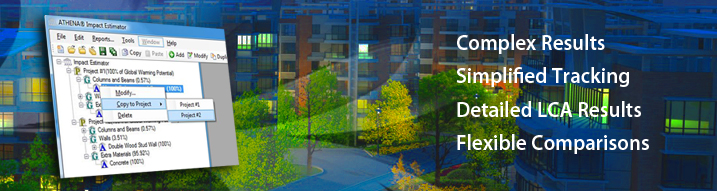
In North America, the Athena Impact Estimator for Buildings is the only free software tool that is designed to evaluate whole buildings and assemblies based on internationally recognized life cycle assessment (LCA) methodology.

2023-08-21

Cradle to Cradle Certified® is the leading multi-attribute standard used globally across industries by designers, brands and manufacturers for designing and making products that enable a healthy, equitable and sustainable future. For more than a decade, Cradle to Cradle Certified has been helping companies to innovate and optimize materials and products according to the world’s most advanced science-based measures.

2023-08-09

EnergyPlus™ is a whole building energy simulation program that engineers, architects, and researchers use to model both energy consumption—for heating, cooling, ventilation, lighting and plug and process loads—and water use in buildings.

2023-08-09

Insight is a tool aimed at architects and engineers to support design of more energy-efficient buildings, using advanced simulation engines, and integration with Revit.