Photo showing aerial view of roof gardens. By Chuttersnap via Unsplash

Policy challenge

The Hub provides resources to support policymakers across the world to transform the construction industry in line with the Paris Agreement, the UN's Sustainable Development Goals, the New Urban Agenda, and the Buildings Breakthrough target.

The built environment sector has the potential to achieve rapid decarbonization by supporting various stakeholders across the entire life cycle of materials, including international supply chains. To optimize building material decarbonization, specific policies should be tailored to the context. Six key strategies are essential for decarbonization: setting higher building code standards, legislating circularity throughout the life cycle, promoting the use of low-carbon, bio-based materials, improving access to data and life-cycle analysis, addressing gender imbalances in the built environment, and demonstrating public sector leadership in finance and procurement.

More specifically, as laid out in the UNFCCC-MPGCA Human Settlements Climate Action Pathway, which aims to guide and drive implementation of the Paris Agreement, two goals for decarbonisation of buildings are in place that the Hub aims to support:

Near-term

By 2030, the built environment should halve its emissions, whereby 100 per cent of new buildings must be net-zero carbon in operation, with widespread energy efficiency retrofit of existing assets well underway, and embodied carbon must be reduced by at least 40 per cent, with leading projects achieving at least 50 per cent reductions in embodied carbon.

Long-term

By 2050 at the latest, all new and existing assets must be net zero across the whole lifecycle, including operational and embodied emissions.

Various policies have been proposed and implemented in some countries to speed this transition towards the above targets. Policies may target a specific phase of the building life cycle, but strategies should consider a range of interventions that address the full life cycle. Early adopters of policies can provide valuable experiences for wider roll-out in other countries. Resources in the Hub provide examples, learnings and ideas of policies in the following areas:

  • Implementing building codes and embodied carbon limits for materials
  • Incentivising more sustainable approaches to construction, such as material re-use, circular design and off-site manufacture
  • Mandating different construction activity where this is possible - e.g. renovation over new construction, deconstruction over demolition
  • Improving and incentivising green certifications for buildings and materials

Resources are included  to address a range of key policy challenges related to building materials. Alongside embodied and operational carbon and circularity, resources are included that can also tackle issues related to chemicals and health, climate adaptation, poverty alleviation through housing, land-use and biodiversity, and responsible material sourcing. 

Filters +
View results
2023-07-21

The major cost of construction is incurred on building materials and most of these building materials are cement products. The ever increasing price of cement coupled with the rise in the price of other construction materials make the construction cost far from the reach of the low and the middle income group of urban dwellers.

2023-07-21

Demand for aluminum in final products has increased 30-fold since 1950 to 45 million tonnes per year, with forecasts predicting this exceptional growth to continue so that demand will reach 2–3 times today’s levels by 2050. Aluminum production uses 3.5% of global electricity and causes 1% of global CO2 emissions, while meeting a 50% cut in emissions by 2050 against growing demand would require at least a 75% reduction in CO2 emissions per tonne of aluminum produced—a challenging prospect.

2023-07-21

The environmental consequences of plastic solid waste are visible in the ever-increasing levels of global plastic pollution both on land and in the oceans. But although there are important economic and environmental incentives for plastics recycling, end-of-life treatment options for plastic solid waste are in practice quite limited.

Presorting of plastics before recycling is costly and time-intensive, recycling requires large amounts of energy and often leads to low-quality polymers, and current technologies cannot be applied to many polymeric materials.

2023-07-21

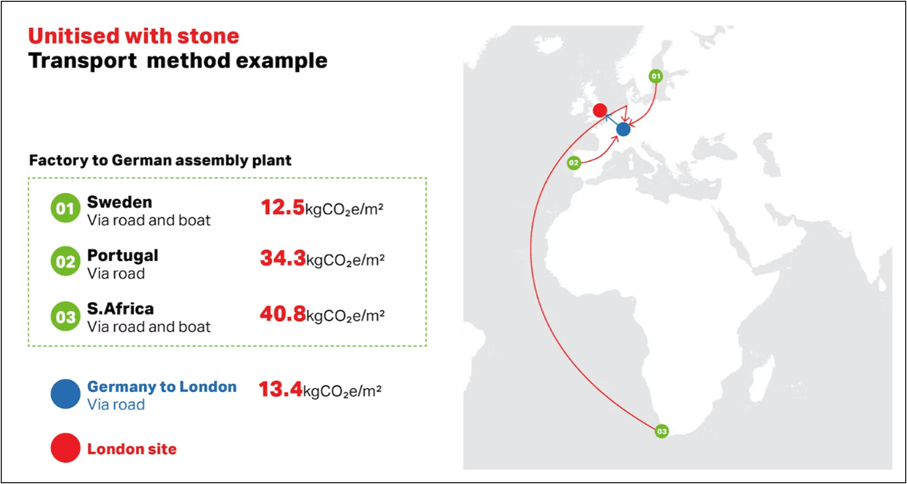
The design and production of the facade system can have a significant effect on the embodied carbon of a building.

The transportation of facade materials and components to a factory, between factories, and to the building site can also have a big impact. Understanding this impact is important in determining the optimum design and specification for a low-carbon building.

Author: Make Architects

2023-07-21

Demolishing unwanted buildings wastes vast quantities of valuable resources, driving up financial and environmental costs. Deconstruction offers a means of salvaging materials for reuse. It also creates more jobs than demolition, spurs local innovation and industry, preserves local character and heritage, reduces landfill costs and limits the need for virgin (and often carbon-intensive) materials.

2023-07-21

The role of plastic materials in construction has become indispensable in the past decades with regard to the global megatrends urbanisation, climate, health, environment and affordable housing. 

2023-07-21

In recent years, awareness of the negative impacts of plastic waste and pollution on our environment has heightened. Popular television documentaries, such as the BBC’s Blue Planet II, and mainstream media campaigns have played a significant role in bringing these issues to the forefront of the public’s consciousness.

The focus of this has largely been on single-use plastics from consumer products and packaging. There has been relatively little attention on the use of plastics in construction, both from a short and long-life perspective.

2023-07-21

Cross laminated timber (CLT) has become a well-known engineered timber product of global interest. The orthogonal, laminar structure allows its application as a full-size wall and floor element as well as a linear timber member, able to bear loads in- and out-of-plane.

This article provides a state-of-the-art report on some selected topics related to CLT, in particular production and technology, characteristic material properties, design and connections.

Authors:

2023-07-21

Renewable and biodegradable materials derived from biomass are attractive candidates to replace non-biodegradable petrochemical plastics. However, the mechanical performance and wet stability of biomass are generally insufficient for practical applications.

2023-07-21

Given increasing concerns for the marine environment and human health, as well as trade restrictions from Asian countries, plastics have become a great challenge for the United States.

This study addresses the seven commonly used plastics: low-density polyethylene/linear low-density polyethylene, high-density polyethylene, polyethylene terephthalate (PET), polypropylene, polystyrene, polyvinyl chloride, and other plastics.