Photo showing aerial view of roof gardens. By Chuttersnap via Unsplash

Policy challenge

The Hub provides resources to support policymakers across the world to transform the construction industry in line with the Paris Agreement, the UN's Sustainable Development Goals, the New Urban Agenda, and the Buildings Breakthrough target.

The built environment sector has the potential to achieve rapid decarbonization by supporting various stakeholders across the entire life cycle of materials, including international supply chains. To optimize building material decarbonization, specific policies should be tailored to the context. Six key strategies are essential for decarbonization: setting higher building code standards, legislating circularity throughout the life cycle, promoting the use of low-carbon, bio-based materials, improving access to data and life-cycle analysis, addressing gender imbalances in the built environment, and demonstrating public sector leadership in finance and procurement.

More specifically, as laid out in the UNFCCC-MPGCA Human Settlements Climate Action Pathway, which aims to guide and drive implementation of the Paris Agreement, two goals for decarbonisation of buildings are in place that the Hub aims to support:

Near-term

By 2030, the built environment should halve its emissions, whereby 100 per cent of new buildings must be net-zero carbon in operation, with widespread energy efficiency retrofit of existing assets well underway, and embodied carbon must be reduced by at least 40 per cent, with leading projects achieving at least 50 per cent reductions in embodied carbon.

Long-term

By 2050 at the latest, all new and existing assets must be net zero across the whole lifecycle, including operational and embodied emissions.

Various policies have been proposed and implemented in some countries to speed this transition towards the above targets. Policies may target a specific phase of the building life cycle, but strategies should consider a range of interventions that address the full life cycle. Early adopters of policies can provide valuable experiences for wider roll-out in other countries. Resources in the Hub provide examples, learnings and ideas of policies in the following areas:

  • Implementing building codes and embodied carbon limits for materials
  • Incentivising more sustainable approaches to construction, such as material re-use, circular design and off-site manufacture
  • Mandating different construction activity where this is possible - e.g. renovation over new construction, deconstruction over demolition
  • Improving and incentivising green certifications for buildings and materials

Resources are included  to address a range of key policy challenges related to building materials. Alongside embodied and operational carbon and circularity, resources are included that can also tackle issues related to chemicals and health, climate adaptation, poverty alleviation through housing, land-use and biodiversity, and responsible material sourcing. 

Filters +
View results
2023-07-21

The increased attention paid to resource efficiency, sustainable use of natural resources and sustainable buildings has raised awareness of the potential of the building sector to contribute to Europe’s goals in these areas.

The Resource Efficiency Roadmap identifies the building sector as one of the sectors that is key to addressing the challenges of energy, climate change and resource efficiency. The Roadmap recognises that increased waste recycling, among other measures, will contribute to a competitive construction sector.

2023-07-21

Construction logistics offer useful solutions to improve both the productivity and sustainability of the industry. The purpose of this paper is to investigate, in detail, the environmental impact of construction transport and whether the building certification scheme for a construction project has any influence on its transport arrangements. The analysis in this paper is based on a multiple case study of 40 Swedish projects.

2023-07-21

Afghanistan has suffered from four decades of war, causing a massive migration of the rural population to the cities. Kabul was originally designed for 1,5 million people, whereas there are now 5 million in the city. The importation of modern western styles housing for rapid reconstruction reveals apparent cultural conflict and a significant environmental footprint.

2023-07-21

Glass is a highly recyclable material, despite which, end-of-life building glass is almost never recycled into new glass products.

In the UK alone, almost 200,000 tonnes of glass is currently sent to landfill each year. In the EU, the proper recycling of all building glass waste could avoid 925,000 tonnes of landfilled waste every year and save around 1.23 million tonnes of primary raw materials annually.

2023-07-21

The temperature of cities continues to increase because of the heat island phenomenon and the undeniable climatic change. The observed high ambient temperatures intensify the energy problem of cities, deteriorates comfort conditions, put in danger the vulnerable population and amplify the pollution problems.

2023-07-21

Over the past four decades, global plastics production has quadrupled. If this trend were to continue, the GHG emissions from plastics would reach 15% of the global carbon budget by 2050. Strategies to mitigate the life-cycle GHG emissions of plastics, however, have not been evaluated on a global scale.

2023-07-21

The transition to a carbon neutral EU requires deep energy demand reductions in key sectors of the economy such as buildings and transport, and that the remaining energy consumed is carbon neutral. Such transformations can only be achieved if the conditions are created for all actors and industrial sectors to maximise their multi-faceted contributions to this low-carbon revolution.

2023-07-12

Thanks to funding from Innovate UK, in collaboration with the NICER programme, a new ‘toolkit’ has been developed as part of the ASBP-led ‘Delivering Innovative Steel ReUse ProjecT‘ (DISRUPT).

2023-05-30

The Construction, Demolition & Deconstruction Policy Toolkit was developed by members of Recycle Colorado’s C&D Council, a group of industry stakeholders including public, private, and nonprofit sector entities working to support construction, demolition and deconstruction (C&D) materials recovery in Colorado.  The toolkit is currently in draft.

2023-05-30

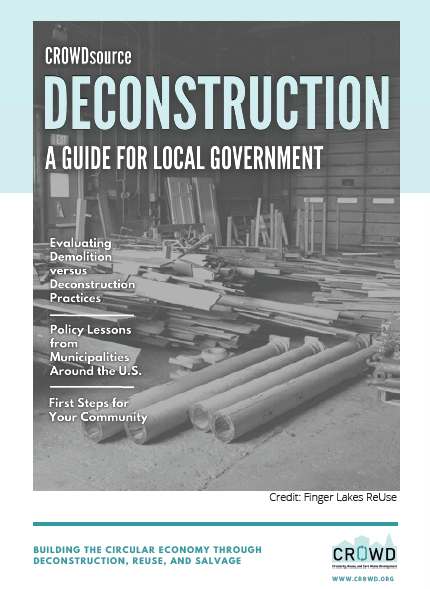
Evaluating demolition versus deconstruction practices - policy lessons from municipalitites around the US.

Faced with housing crises, aging building stock, landfill concerns, and climate impacts to the builtenvironment, municipalities and states are increasingly turning  their attention to deconstruction and building material reuse as an alternative to demolition.