


Intergovernmental Council for Buildings and Climate (ICBC)
In March 2024, the Buildings and Climate Global Forum in Paris marked an important step for the building sector's role in global climate action. The event culminated in the adoption of the Déclaration de Chaillot, endorsed by over 60 countries, establishing the Intergovernmental Council for Buildings and Climate (ICBC). This council brings together governments to collaborate on accelerating decarbonization and resilience in the building sector, aligning national actions with international climate goals. ICBC, officially launched at COP29, is coordinated by the Global Alliance for Buildings and Construction (GlobalABC) and operates within the framework set forth in the Declaration.

LATEST: First ICBC Ministerial Meeting at COP30
Ministers launched the Belém Call for Action for Sustainable and Affordable Housing: Read the full news here
Access the ICBC Ministerial outcome document here
Role and Objectives
The Intergovernmental Council for Buildings and Climate (ICBC) serves as a high-level political framework fueled by the recommendations, evidence, and insights generated by the GlobalABC Hubs and Action Groups, among other relevant processes and initiatives.
The ICBC process is anchored in the Chaillot Declaration, which provides the overarching mandate and has been endorsed by all ICBC members. From this Declaration flow some thematic priorities, identified by the Troika for a two-year mandate (with the current term covering 2025–27), along with additional topics proposed by ICBC members. Together with inputs from GlobalABC Hubs and Action Groups, the Buildings Breakthrough, and other aligned initiatives, these priorities and topics form the basis of ICBC Technical Meetings, where members collaborate, share experiences, and build consensus. The outcomes of these discussions shape a pipeline of products, some of which are proposed for endorsement or acknowledgement at Ministerial level, while others are acknowledged at Technical level. Once agreed, these products reflect collective political support, remain grounded in the Chaillot Declaration, and move forward into implementation and progress tracking to advance its commitments.
Its primary functions include:
- Facilitating International Cooperation
ICBC enables countries to exchange knowledge, share successes and challenges, and explore effective policies for sustainable building practices, energy efficiency, and climate adaptation.
- Aligning Policies with Global Goals
Supporting the alignment of national initiatives in the building sector with the Paris Agreement’s objectives for decarbonization and resilience.
- Review Progress
Reviewing the implementation of decarbonization strategies and climate resilience measures in the building sector, while fostering global collaboration and knowledge sharing.
- Guiding Global Action
Developing policy recommendations, issuing common statements, and providing technical briefs to assist member states in advancing sustainable transformation in the building sector.

ICBC Products
The ICBC develops and endorses policy products through extensive consultations with member countries. At the first Ministerial Meeting at COP30, ministers endorsed and acknolwedge a number of products including the Belém Call for Action for Sustainable and Affordable Housing. Learn more about the outcomes of the ICBC Ministerial here.
- Belém Call for Action for Sustainable and Affordable Housing
The Belém Call for Action for Sustainable and Affordable Housing launched at the first ICBC Ministerial Meeting at COP30, positions housing affordability and climate sustainability as interconnected priorities. It calls on governments to integrate climate action into housing policy, establish innovative financing mechanisms for sustainable affordable housing, and align national policies with climate goals by 2030–2035.
Read and download the full Belém Call for Action: The complete text of the ministerial commitment for Sustainable and Affordable Housing with time-bound targets for 2030 and 2035, along with the one-page summary flyer.- Global Framework for Action on Sustainable Public Procurement
Recognizing that public procurement accounts for up to 13 per cent of global GDP and 15 per cent of global greenhouse gas emissions, the Global Framework for Action recognises sustainable public procurement (SPP) as a strategic policy lever—rooted in a demand-based approach—to drive market transformation and accelerate the shift toward a near-zero emissions, climate-resilient built environment by 2030. This framework is as a powerful instrument to advance sustainability and climate goals through government purchasing power. Learn more on the Global Framework for Action on Sustainable Public Procurement here
- Principles for Responsible Timber Construction
The Principles for Responsible Timber Construction establish a common language and global framework to ensure that increased demand for wood is managed responsibly. They maximise benefits for climate, nature, and people, while supporting forests, transforming the built environment, and enabling thriving bioeconomies. These principles promote bio-based materials and circular construction practices, supporting sustainable forestry and reducing embodied carbon in buildings. Learn more about the Principles for Responsible Timber Construction here.
- World Championship for Energy Savings (WCES)
By engaging public administrations and major building operators, the WCES enables rapid, measurable, and replicable energy savings, turning sufficiency and efficiency into visible national achievements. This initiative encourages faster improvements in energy intensity in the commercial sector, demonstrating that cost-effective energy efficiency measures are within reach for buildings worldwide. Learn more about the World Championship for Energy Savings here
Members and Observers
Governments that have expressed interest in joining ICBC and have endorsed the Déclaration de Chaillot are recognized as members. Those that have shown interest but have not yet endorsed the declaration participate as "Observer States." While Observer States can attend meetings, they do not have decision-making or governance roles.
- ICBC Members: 53

Armenia

Bangladesh

Brazil

Bulgaria

Cambodia

Canada

Costa Rica

Côte d'Ivoire

Croatia

Czech Republic

Denmark

Estonia

European Commission

Finland

Fiji

France

Gabon

Germany

Ghana

Greece

Italy

Japan

Jordan

Kenya

Kosovo

Latvia

Liberia

Lithuania

Luxembourg

Malta

Mauritania

Monaco

Mongolia

Montenegro

Morocco

Netherlands

New Zealand

Poland

Portugal

Republic of Korea

Somao

Senegal

Somalia

Spain

Sri Lanka

Tunisia

Türkiye

Uganda

United Arab Emirates

United Kingdom

United States

Uruguay

Zambia
Additionally, the following countries have endorsed the Déclaration de Chaillot and are in the process of formally confirming their participation in the ICBC: Australia, Austria, Djibouti, Egypt, Guinea-Bissau, Ireland, Republic of Lebanon, Peru, Philippines, Rwanda and Uzbekistan.
- ICBC Observers: 16

Algeria

Burkina Faso

Dominican Republic

Eritrea

Indonesia

Kiribati

Madagascar

Maldives

Mauritius

Mexico

Moldova

Nepal

South Africa

State of Palestine

Suriname

Ukraine
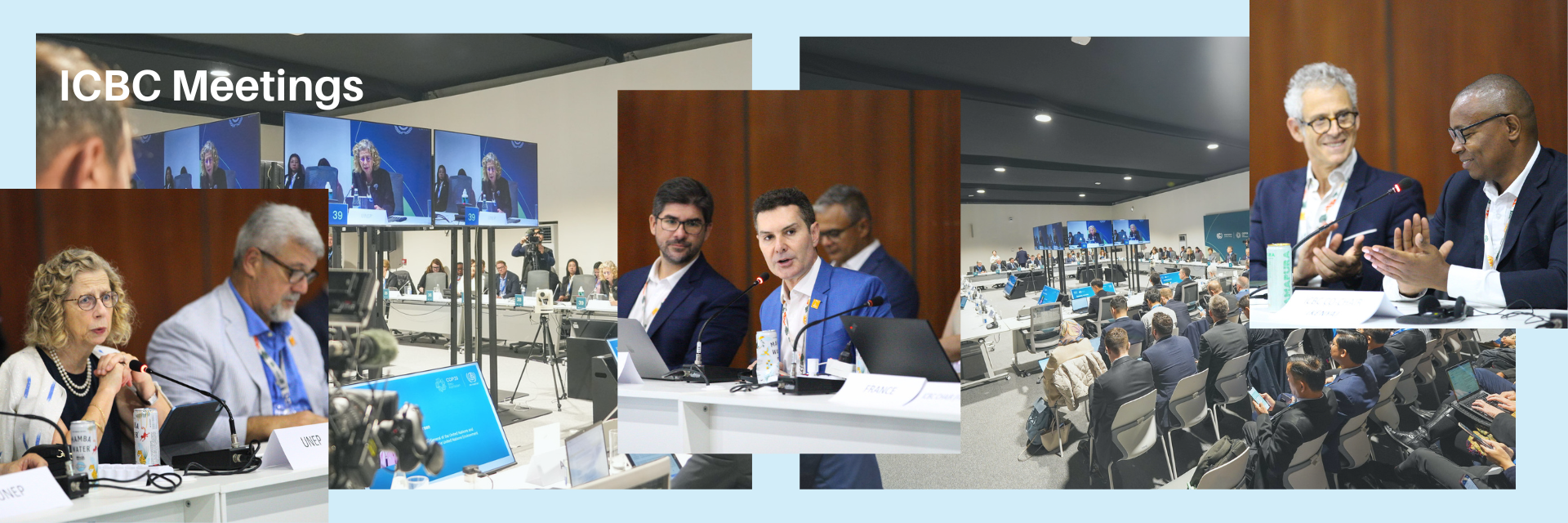
Meetings
- 2026
- ICBC First In-Person Technical Meeting at SBCS26 (21 April 2026): The first in-person gathering of the ICBC brought together country-designated Senior Representatives from 30 countries on the sidelines of the Sustainable Buildings and Construction Summit in Lausanne. Building on the political momentum of the Ministerial at COP30 in Belém, discussions covered progress in implementing the Déclaration de Chaillot, the operational modalities guiding the ICBC's processes, and country needs to inform the design of the proposed ICBC Country Dialogues. Dedicated sessions also advanced three key workstreams: the launch of the World Championship for Energy Savings platform; a panel on property-linked finance (PLF) for building retrofits; and a discussion on policies for blended cements and supplementary cementitious materials (SCMs).
- 2025
- ICBC First Ministerial Meeting at COP30 (11 November 2025) launching the Belém Call for Action for Sustainable and Affordable Housing and a series of additional ICBC products. The high-level gathering brought together ministers and senior government representatives to catalyse global cooperation on climate action in the buildings sector, addressing the interconnected challenges of climate change, housing affordability, and building sector decarbonisation. For more on the ministerial, the outcomes and further resources, please click here. Read the outcomes document here.
- ICBC Additional Technical Meeting (6 October 2025): The ICBC secretariat convened an additional session to advance preparations for COP30. Discussions focused on final negotiations of the Belém Call to Action for sustainable, efficient, low-carbon, and climate-resilient affordable housing; the presentation of the Endorsement/Acknowledgement Form for the ICBC COP30 package of products; and the consideration of additional products for potential endorsement or acknowledgement. For more on the session, including the agenda and further resources, please click here.
- ICBC Bi-Annual Technical Meeting (15 September 2025): The second technical meeting of 2025 provided an opportunity for ICBC members and observers to take stock of progress and shape the Council’s collective input to COP30 in Belém. In coordination with the Troika (France, Brazil, and Kenya), discussions centered on the priorities of sustainable and affordable housing and unlocking finance, as well as candidate policy products that could be put forward to Ministers at the ICBC Ministerial. For more on the session, including the agenda and further resources, please click here.
- ICBC Bi-Annual Technical Meeting (25 March 2025): The first bi-annual technical meeting of the Intergovernmental Council for Buildings and Climate (ICBC) in 2025 convened senior representatives from member states and observers. Following the official inauguration of the ICBC at COP29, and in coordination with the ICBC Troika (France, Brazil, and Kenya), the meeting supported ongoing efforts to define the Council’s priorities, engagement processes, and milestones for 2025–2027. It provided a forum to advance the implementation of the Déclaration de Chaillot, share national priorities, exchange best practices, discuss reporting mechanisms, and coordinate next steps in preparation for COP30. For more on the session, including the agenda and further resources, please click here.
Watch the ICBC First Ministerial Meeting at COP30
- 2024
- First Information Meeting: Held online in two sessions on 26 September 2024.
- Second Information Meeting: Hosted by the OECD on 10 October 2024, as part of the 3rd OECD Sustainable Buildings Roundtable.
- Institutionalization of ICBC: Achieved on 20 November 2024 at COP29 during the High-Level Roundtable on Green Construction, Energy Efficiency in Buildings, and Climate Resilience. Ministers and high representatives from Brazil, Estonia, France, the UK, Kenya, Lithuania, Tanzania, Uganda, and others participated in the event. You can download the summary report or watch the event recording below. For more on the session, including the agenda and further resources, please click here.
Watch the ICBC Inauguration at COP29
Troika Leadership
The ICBC's leadership comprises a troika, with France as Chair and Brazil and Kenya as Vice-Chairs, demonstrating a collaborative, global approach to sustainable buildings. As part of this leadership, Brazil hosted the ICBC ministerial meeting at COP30.
- Agnès Pannier-Runacher, Minister of Ecological Transition, Energy, Climate, and Risk Prevention, France
"France is firmly committed to decarbonizing buildings, with ambitious energy efficiency regulations already in place. Now, a global mobilization is essential to address the climate challenges of this sector. The institutionalization of the ICBC under the Declaration de Chaillot represents a critical political milestone. Our ambition is to make the ICBC a key tool for ministers driving this transformation."
- Jader Barbalho Filho, Minister of Cities, Brazil
"Aligned with our commitment to the Declaration de Chaillot, Brazil recognizes the construction sector's potential to mitigate climate change effects. Social housing programs are central to this vision. Through the new federal financial program (PAC), investments in slum redevelopment and social housing are key initiatives to support vulnerable families by improving and constructing residential buildings. Climate justice is inseparable from social justice, and local actors’ efforts are vital to reaffirming the goals of the Declaration."
- Alice Wahome, Minister of Lands, Public Works, Housing, and Urban Development, Kenya
"Kenya is at a turning point in its efforts to combat climate change, particularly in the construction sector. With significant progress made under our Vision 2030 initiative, we aim to integrate climate considerations into building practices and promote green technologies. As part of the ICBC troika, Kenya is committed to enhancing coordination and international cooperation to ensure climate-conscious development."
How to Join
Countries interested in officially joining ICBC and endorsing the Déclaration de Chaillot are required to complete the following steps. For any additional information or questions, please contact the GlobalABC Secretariat at [email protected], ensuring to include "ICBC" in the email subject line.
- Download and complete the Endorsement Template to become a member of ICBC (only for governments)
The template is available in English, French, Spanish, and Portuguese.
- Template for Notification of Participation in the Intergovernmental Council for Buildings and Climate (ICBC).docx
- Modèle pour la Notification de Participation au Conseil Intergouvernemental pour les Bâtiments et le Climat (ICBC).docx
- Modelo para la Notificación de Participación en el Consejo Intergubernamental para Edificaciones y Clima (ICBC).docx
- Modelo para Notificação de Participação no Conselho Intergovernamental para Edificações e Clima (ICBC).docx
Fill in all required information.
- Submit the Completed Template
Send the completed document to [email protected], ensuring that [email protected], [email protected] and [email protected] are copied (CC) on the correspondence.
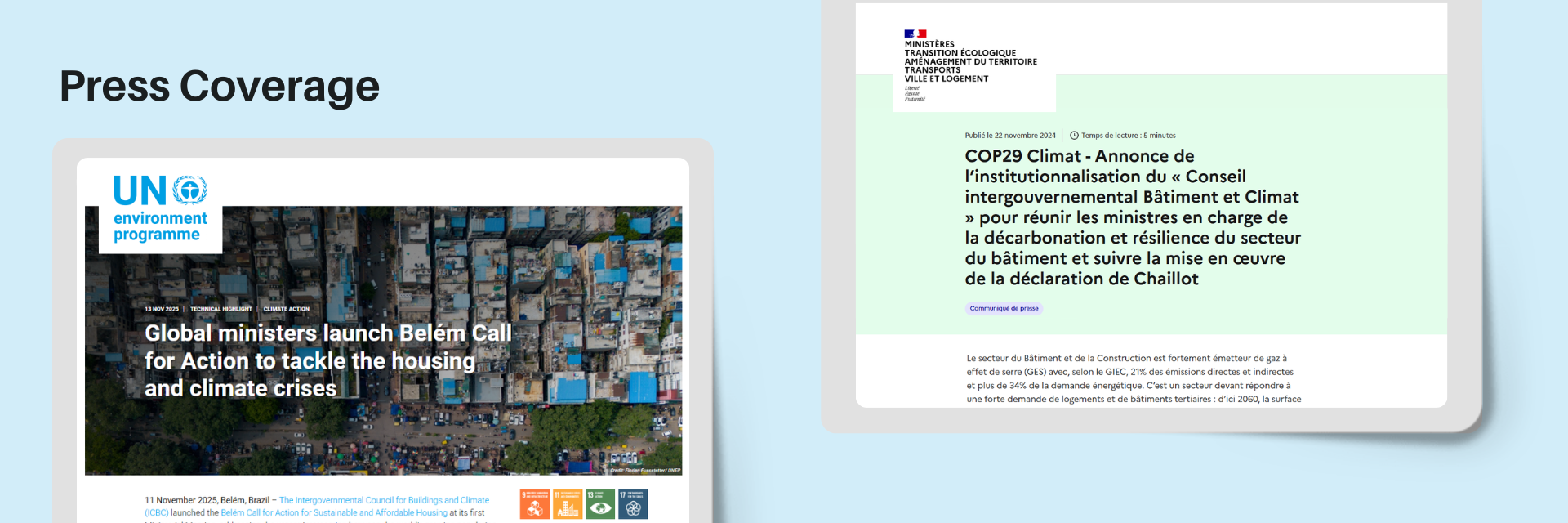
Press Coverage & Headlines
- Press Releases and Technical Highlights
👉 Technical Highlight: Global ministers launch Belém Call for Action to tackle the housing and climate crises at COP30 (UNEP, 2025)
👉 Press Release COP29 - Announcement of the institutionalization of the Intergovernmental Council on Buildings and Climate (France, 2024)
👉 Technical Highlight on the Intergovernmental Council for Buildings and Climate launches at COP29 (UNEP, 2024)
- Media Coverage
👉 Global Climate Action Agenda at COP30 Outcomes Report (COP30, 2025)
👉 COP30 Evening Summary – November 11 (COP30, 2025)
👉 Habitat for Humanity International’s Response to the Belém Call to Action on Sustainable and Affordable Housing (Habitat for Humanity International, 2025)
👉 Speech Delivered by Inger Andersen for the ICBC First Ministerial Meeting: Making the buildings sector a beacon for climate action (UNEP, 2025)
👉 COP30 Puts Sustainable Public Procurement in the Spotlight as UNEP Lead Key Climate Action Initiatives (One Planet Network, 2025)
👉 COP29: Bold on buildings? (WBCSD, 2024)
👉 Summary of Global Climate Action at COP 29 (UNFCCC, 2024)


