Photo showing aerial view of roof gardens. By Chuttersnap via Unsplash

Policy challenge

The Hub provides resources to support policymakers across the world to transform the construction industry in line with the Paris Agreement, the UN's Sustainable Development Goals, the New Urban Agenda, and the Buildings Breakthrough target.

The built environment sector has the potential to achieve rapid decarbonization by supporting various stakeholders across the entire life cycle of materials, including international supply chains. To optimize building material decarbonization, specific policies should be tailored to the context. Six key strategies are essential for decarbonization: setting higher building code standards, legislating circularity throughout the life cycle, promoting the use of low-carbon, bio-based materials, improving access to data and life-cycle analysis, addressing gender imbalances in the built environment, and demonstrating public sector leadership in finance and procurement.

More specifically, as laid out in the UNFCCC-MPGCA Human Settlements Climate Action Pathway, which aims to guide and drive implementation of the Paris Agreement, two goals for decarbonisation of buildings are in place that the Hub aims to support:

Near-term

By 2030, the built environment should halve its emissions, whereby 100 per cent of new buildings must be net-zero carbon in operation, with widespread energy efficiency retrofit of existing assets well underway, and embodied carbon must be reduced by at least 40 per cent, with leading projects achieving at least 50 per cent reductions in embodied carbon.

Long-term

By 2050 at the latest, all new and existing assets must be net zero across the whole lifecycle, including operational and embodied emissions.

Various policies have been proposed and implemented in some countries to speed this transition towards the above targets. Policies may target a specific phase of the building life cycle, but strategies should consider a range of interventions that address the full life cycle. Early adopters of policies can provide valuable experiences for wider roll-out in other countries. Resources in the Hub provide examples, learnings and ideas of policies in the following areas:

  • Implementing building codes and embodied carbon limits for materials
  • Incentivising more sustainable approaches to construction, such as material re-use, circular design and off-site manufacture
  • Mandating different construction activity where this is possible - e.g. renovation over new construction, deconstruction over demolition
  • Improving and incentivising green certifications for buildings and materials

Resources are included  to address a range of key policy challenges related to building materials. Alongside embodied and operational carbon and circularity, resources are included that can also tackle issues related to chemicals and health, climate adaptation, poverty alleviation through housing, land-use and biodiversity, and responsible material sourcing. 

Filters +
View results
2022-01-01

The GreenScreen List Translator™ provides a “list of lists” approach to quickly identify chemicals of high concern. It does this by scoring chemicals based on information from over 40 hazard lists developed by authoritative scientific bodies convened by international, national and state governmental agencies, intergovernmental agencies and NGOs. These GreenScreen Specified Lists include REACH categorizations and chemical hazard classifications by countries using the Globally Harmonized System of Classification and Labelling of Chemicals (GHS).

2022-01-01

This short online course from the Life Cycle Initiative provides grounding on lifecycle thinking for policy makers. This is delivered via a series of video lessons, reading materials, and quizzes around the application of life cycle thinking in different areas of policy. The areas covered include those relevant to the built environment and urban planning, including transport and waste policy.

2022-01-01

HBN's Product Guidance uses a red-to-green ranking system to compare different types of products based on their hazardous content. It is informed by our comprehensive research into the hazards associated with building products that may impact building occupants as well as fenceline communities and workers throughout the product's life cycle.

2021-11-01

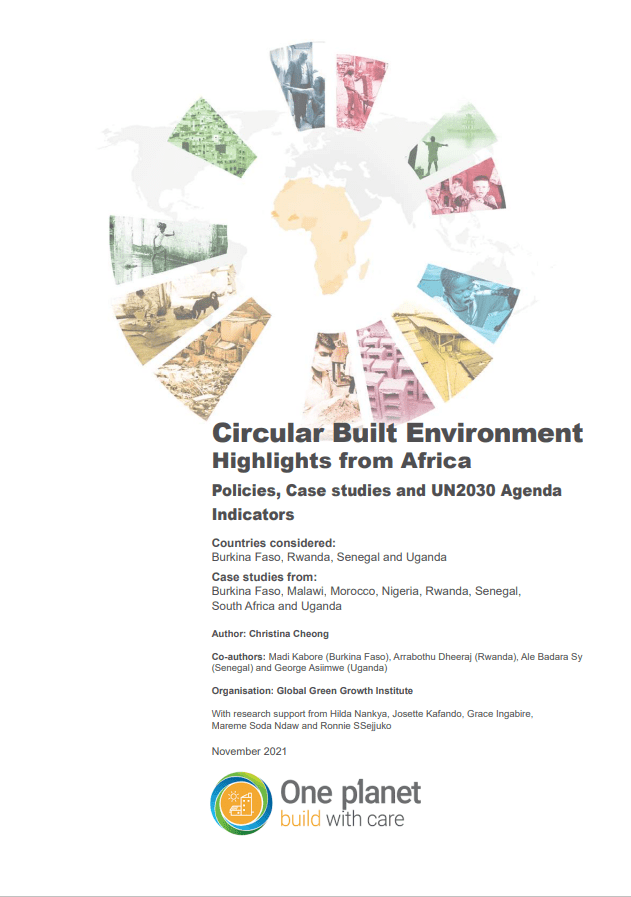
Policy briefing paper focusing on four countries in Africa: Burkina Faso, Rwanda, Senegal and Uganda. Through policy analysis and stakeholder interviews, this report presents the operating context for the building industry in these countries and the concept of circularity through all phases of the building life cycle. Nineteen of these examples are featured as case studies in this report and provide insights to the current initiatives on circularity in buildings. Case studies featured also include projects and practices from Malawi, Morocco, Nigeria and South Africa. 

2021-09-01

Policy brief paper analysing the policy, legal and regulatory frameworks governing the cement sector in Nigeria, Africa, and examines the policies required to encourage increased use of bioenergy in cement production.

2021-09-01

A comprehensive resource for cities and other government bodies seeking to develop strategies, action plans and policies to tackle embodied carbon. The report identifies and assesses policy types and urban planning approaches to create a sustainable built environment in terms of embodied carbon, with best practices drawn mostly from cities in Europe and North America alongside new policies that have yet to be implemented.

2021-09-01

Study into the key aspects of international best practices of green public procurement policies that can be adopted in the USA for successful design and implementation of the Federal Buy Clean initiative. The Buy Clean initiative calls for the prioritisation of American-made, lower-carbon construction materials in federal procurement and federally assisted projects in North America.


2021-08-01

User-friendly overview of proven and scalable solutions to reduce concrete’s contribution to climate change. This guide highlights six key opportunities to reduce embodied carbon in concrete products without compromising financial or material performance.

2021-07-05

The SDG 12 Hub is a one-stop-shop for governments, businesses, civil society and the public for tracking progress on the achievement of Goal 12 of the 2030 Agenda for Sustainable Development: ensuring sustainable consumption and production patterns.

The SDG 12 Hub supports the transformation to sustainable consumption and production practices by offering direct access to transparent data, impactful solutions, guidance and official reporting all in one place, and facilitates the sharing of progress, knowledge and solutions for sustainable consumption and production.

2021-06-25

With the ÖKOBAUDAT platform, the Federal Ministry for Housing, Urban Development and Building (BMWSB) Germany provides all stakeholders with a standardized database for the life cycle assessment of buildings. At the heart of the platform is the online database with life cycle assessment data on building materials, construction, transport, energy and disposal processes. With the help of life cycle assessment tools, such as the eLCA provided by the BBSR, the entire life cycle of a building can be compiled with the ÖKOBAUDAT database.