Photo showing aerial view of roof gardens. By Chuttersnap via Unsplash

Policy challenge

The Hub provides resources to support policymakers across the world to transform the construction industry in line with the Paris Agreement, the UN's Sustainable Development Goals, the New Urban Agenda, and the Buildings Breakthrough target.

The built environment sector has the potential to achieve rapid decarbonization by supporting various stakeholders across the entire life cycle of materials, including international supply chains. To optimize building material decarbonization, specific policies should be tailored to the context. Six key strategies are essential for decarbonization: setting higher building code standards, legislating circularity throughout the life cycle, promoting the use of low-carbon, bio-based materials, improving access to data and life-cycle analysis, addressing gender imbalances in the built environment, and demonstrating public sector leadership in finance and procurement.

More specifically, as laid out in the UNFCCC-MPGCA Human Settlements Climate Action Pathway, which aims to guide and drive implementation of the Paris Agreement, two goals for decarbonisation of buildings are in place that the Hub aims to support:

Near-term

By 2030, the built environment should halve its emissions, whereby 100 per cent of new buildings must be net-zero carbon in operation, with widespread energy efficiency retrofit of existing assets well underway, and embodied carbon must be reduced by at least 40 per cent, with leading projects achieving at least 50 per cent reductions in embodied carbon.

Long-term

By 2050 at the latest, all new and existing assets must be net zero across the whole lifecycle, including operational and embodied emissions.

Various policies have been proposed and implemented in some countries to speed this transition towards the above targets. Policies may target a specific phase of the building life cycle, but strategies should consider a range of interventions that address the full life cycle. Early adopters of policies can provide valuable experiences for wider roll-out in other countries. Resources in the Hub provide examples, learnings and ideas of policies in the following areas:

  • Implementing building codes and embodied carbon limits for materials
  • Incentivising more sustainable approaches to construction, such as material re-use, circular design and off-site manufacture
  • Mandating different construction activity where this is possible - e.g. renovation over new construction, deconstruction over demolition
  • Improving and incentivising green certifications for buildings and materials

Resources are included  to address a range of key policy challenges related to building materials. Alongside embodied and operational carbon and circularity, resources are included that can also tackle issues related to chemicals and health, climate adaptation, poverty alleviation through housing, land-use and biodiversity, and responsible material sourcing. 

Filters +
View results
2022-11-30

Canada's national guidelines for whole-building life cycle assessment.  This document provides comprehensive instruction for the practice of life cycle assessment applied to buildings, based on relevant standards and keyed to various intentions. The goal is to harmonize the practice of whole-building life cycle assessment (wbLCA) across different studies and assist in interpretation of and compliance with relevant standards. This resource can support the development of similar guideline policies in North America and internationally.

2022-11-29

Guidance exploring ways circular economy business models provide added benefits, such as eco-innovation, throughout the value chain in construction.

2022-11-28

The Carbon Leadership Forum has created a Carbon Policy Toolkit, found here— an array of resources to support the crafting of policies to radically reduce embodied carbon in North America, the USA, and beyond. 

2022-11-28

Design and construction teams have a growing number of strategies and tools to choose from to reduce embodied carbon in their projects. This template, found here, provides a checklist for project teams in North America (USA) to use and adapt. The template makes it easier for teams to systematically discuss if they have considered strategies that may be relevant to their projects.

2022-11-28

The Embodied Carbon in Construction Calculator (EC3) tool is a free and easy-to-use tool that allows benchmarking, assessment and reductions in embodied carbon, focused on the upfront supply chain emissions of construction materials.

2022-10-05

This best practice guide to Materials Passports, by BAMB (Buildings as Materials Banks), provides a guide for actors along the construction value chain and shows the benefits of materials passports and how these can be implemented into general building practice. The publication also provides an overview of the types of material and product-related information.  

2022-10-05

The BRIC project is an educational tool to raise awareness and inform trainers and the construction and education sector about the circular economy in Europe. 

2022-10-01

The Clean Construction Policy Explorer on the C40 Knowledge Hub is an interactive dashboard showing how cities around the world are supporting the transition towards a resource-efficient and low- to zero-emissions construction sector. The map is a living document and C40 will keep it up to date as new policies are developed.

2022-05-01

This paper describes how, when substituted for concrete and steel, mass timber is a carbon-absorbing, energy-efficient, lower-cost, durable and mendable building material that can help deliver affordable urban housing and rural livelihood opportunities. It is suitable for Africa, where trees grow faster than in temperate climates. Africa can mitigate climate change and achieve other developmental benefits using mass timber in its construction sector. Governments and other development actors can support the transition.

2022-02-15

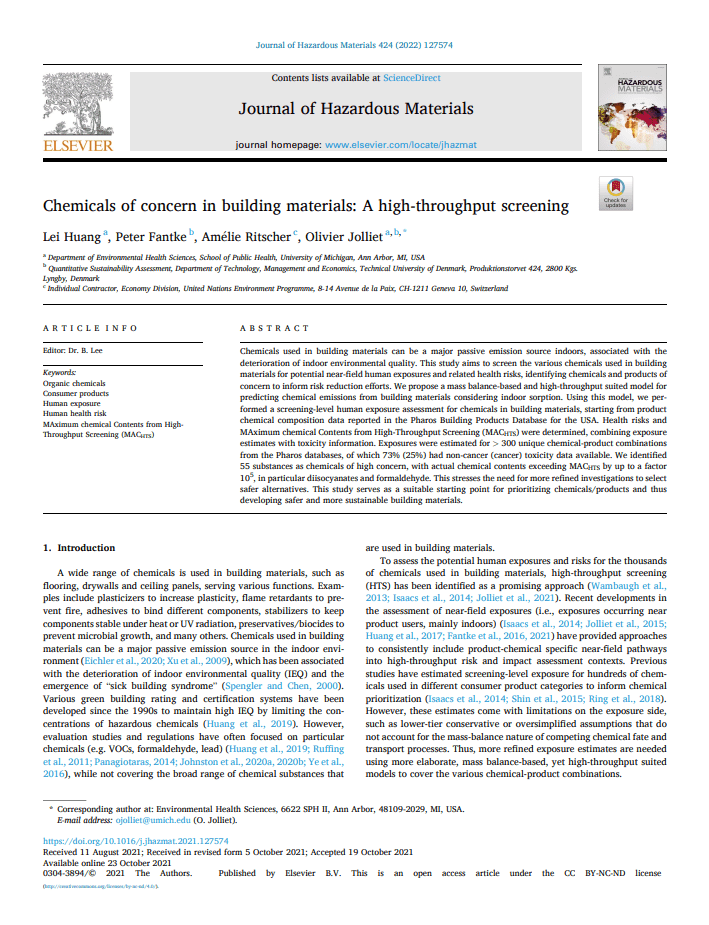
This study aims to screen the various chemicals used in building materials for potential near-field human exposures and related health risks, identifying chemicals and products of concern to inform risk reduction efforts.