Photo of BedZED eco village showing colourful wind cowls. Copyright Bioregional.

Building use

Different building types and uses present a range of sustainability challenges and opportunities, with varying governance and decision-making factors involved. 

A range of approaches and policies appropriate to the type and use case can drive sustainability improvements for domestic, commercial and municipal buildings. Additionally, it is estimated that a billion people live in slums or informal settlements.  Consideration of how to improve sustainability of housing, alongside living standards for this group of people forms a significant part of the global challenge in this area. 

Sustainable public procurement is a powerful tool to improve the sustainability of municipal construction, which includes schools, hospitals, government buildings, social housing and the built environment. Expenditure by public authorities on goods, services, and infrastructure accounts on average for 13% of the gross domestic product in OECD countries, and up to 30% in many developing countries. Globally, the public sector accounts for 20-30% of revenues in the construction industry.

d

Photo credit © Unsplash / Ricardo Gomez Angel

Avoid’ strategies in this context should seek to build with less, avoid over-ordering and waste, and improve material circularity. For municipal buildings, there is an opportunity to enable adaptive re-use within a portfolio, or specify deconstruction instead of premature demolition.

Extending building lifetimes can reduce demand for materials and the embodied carbon expended. In the International Energy Agency’s most ambitious decarbonization scenario, extending building lifetimes would contribute to more than 90 per cent of the CO2 emission reductions for both steel and cement by 2060 (IEA 2019). Sustainable public procurement of more circular construction services, or contracts that specify material recovery targets, can reduce costs, as well as providing sustainability benefits for public authorities.  

Public sector procurement can also provide an opportunity to act as an early adopter of using more innovative materials and contribute to market transformation - more and more examples of public buildings deploying a ‘Shift’ strategy towards more sustainable materials are being seen.  And due to their relatively large purchasing power for materials such as concrete and steel in buildings and infrastructure projects, opportunities exist for ‘Improve’ strategies that can reduce the impacts of these materials within public procurement.

Domestic buildings, constructed by private sector companies have a different set of opportunities and challenges to move towards a more sustainable norm.  Where achieving the lowest cost is a driver, the use of sustainable materials may be deprioritised.  A combination of innovation on materials and construction practices, and an enabling environment of policies to reduce costs, can help push the domestic construction market towards increased use of sustainable materials. In some countries, it is vital to support industry to ‘leapfrog’ the use of higher carbon, conventional materials where there are more sustainable options.

Resources addressing the impacts of materials used in informal settlements are available on the Hub - these include case studies and research papers on how this type of community can act to reduce waste and health hazards as part of materials sourced, whilst improving living standards.

Best practices for different building uses need to be demonstrated and evaluated to show what is possible, driving policy and market support for more sustainable material use and design. Resources include planning tools, policy analysis and best practice case studies of buildings and materials, intended to inspire and promote action for the range of different building types and infrastructure projects.


Filters +
View results
2023-07-21

The major cost of construction is incurred on building materials and most of these building materials are cement products. The ever increasing price of cement coupled with the rise in the price of other construction materials make the construction cost far from the reach of the low and the middle income group of urban dwellers.

2023-07-21

Demand for aluminum in final products has increased 30-fold since 1950 to 45 million tonnes per year, with forecasts predicting this exceptional growth to continue so that demand will reach 2–3 times today’s levels by 2050. Aluminum production uses 3.5% of global electricity and causes 1% of global CO2 emissions, while meeting a 50% cut in emissions by 2050 against growing demand would require at least a 75% reduction in CO2 emissions per tonne of aluminum produced—a challenging prospect.

2023-07-21

The environmental consequences of plastic solid waste are visible in the ever-increasing levels of global plastic pollution both on land and in the oceans. But although there are important economic and environmental incentives for plastics recycling, end-of-life treatment options for plastic solid waste are in practice quite limited.

Presorting of plastics before recycling is costly and time-intensive, recycling requires large amounts of energy and often leads to low-quality polymers, and current technologies cannot be applied to many polymeric materials.

2023-07-21

The design and production of the facade system can have a significant effect on the embodied carbon of a building.

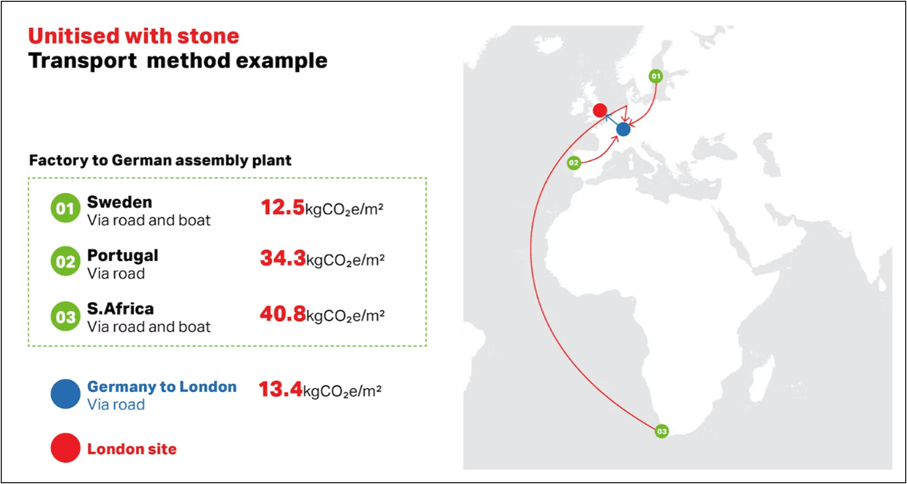
The transportation of facade materials and components to a factory, between factories, and to the building site can also have a big impact. Understanding this impact is important in determining the optimum design and specification for a low-carbon building.

Author: Make Architects

2023-07-21

Demolishing unwanted buildings wastes vast quantities of valuable resources, driving up financial and environmental costs. Deconstruction offers a means of salvaging materials for reuse. It also creates more jobs than demolition, spurs local innovation and industry, preserves local character and heritage, reduces landfill costs and limits the need for virgin (and often carbon-intensive) materials.

2023-07-21

The role of plastic materials in construction has become indispensable in the past decades with regard to the global megatrends urbanisation, climate, health, environment and affordable housing. 

2023-07-21

In recent years, awareness of the negative impacts of plastic waste and pollution on our environment has heightened. Popular television documentaries, such as the BBC’s Blue Planet II, and mainstream media campaigns have played a significant role in bringing these issues to the forefront of the public’s consciousness.

The focus of this has largely been on single-use plastics from consumer products and packaging. There has been relatively little attention on the use of plastics in construction, both from a short and long-life perspective.

2023-07-21

Cross laminated timber (CLT) has become a well-known engineered timber product of global interest. The orthogonal, laminar structure allows its application as a full-size wall and floor element as well as a linear timber member, able to bear loads in- and out-of-plane.

This article provides a state-of-the-art report on some selected topics related to CLT, in particular production and technology, characteristic material properties, design and connections.

Authors:

2023-07-21

Renewable and biodegradable materials derived from biomass are attractive candidates to replace non-biodegradable petrochemical plastics. However, the mechanical performance and wet stability of biomass are generally insufficient for practical applications.

2023-07-21

Given increasing concerns for the marine environment and human health, as well as trade restrictions from Asian countries, plastics have become a great challenge for the United States.

This study addresses the seven commonly used plastics: low-density polyethylene/linear low-density polyethylene, high-density polyethylene, polyethylene terephthalate (PET), polypropylene, polystyrene, polyvinyl chloride, and other plastics.