Photo showing construction cranes. By Ej Yao via Unsplash

Life cycle stage

Life cycle thinking is a crucial part of planning, decision making, and actions to improve the sustainability of construction and building and construction materials. ​​A whole life cycle approach requires consideration of the environmental impact of material choices before the materials are even extracted, and then at each phase of the building lifecycle, from extraction to processing, installation, use and demolition. This means thinking about how the choice of materials affects everything from the functioning of regional ecosystems, to the amount of heating or cooling needed, and how, at the end of their use, these materials can provide a bank of resources to then be re-used. 

This approach is core to tackling the challenges of reducing whole life carbon emissions of buildings, improving material efficiency and the circularity of processes, making building materials chemically safer, and addressing social hotspots in the material life cycle. Failing to consider the whole life cycle in decision making can lead to unintended trade-offs between environmental, social or economic issues that inhibits progress towards sustainable development.

Policymakers play a crucial role to support stakeholders in decarbonizing materials throughout their entire life cycle, from extraction and processing to installation and demolition. Although there are various recommendations for individual stakeholders like manufacturers, architects, owners, and builders to improve the carbon footprints of buildings, these efforts often face challenges due to interdependencies, which means they cannot achieve significant impacts on their own. Instead, stakeholders need simultaneous support to take complementary actions.

5
Source: United Nations Environment Programme (2023). Building Materials and the Climate: Constructing a New Future. Nairobi

For instance, designers, owners, and communities may want to use more recycled materials, but they are hindered by the gap between supply and demand. Closing this gap requires cities to introduce and enforce building codes that promote the use of 'circular' material components, enabling the re-use of materials at the end-of-life. Even incremental improvements across different life cycle phases can synergistically contribute to reducing emissions more effectively than focusing on isolated changes.

Yet, to scale up and have a meaningful impact, all these shifts and improvements require coordinated efforts across producers, designers, builders, and communities, considering the entire life cycle of buildings.

The Hub features a range of research papers, guidance on methodology and case studies that demonstrate taking a whole life cycle approach to improving the sustainability of building materials. Additionally, some resources focus more on a particular life cycle stage, such as recommendations for end-of-life actions to improve circularity. These can be accessed by selecting a particular life cycle stage from the menu.

The Hub also supports the approach of the UNEP Life Cycle Initiative. This is a public-private, multi-stakeholder partnership enabling the global use of credible life cycle knowledge by private and public stakeholders, with building materials being a key focus area for promoting best practice in life cycle thinking.


Filters +
View results
2023-07-21

The major cost of construction is incurred on building materials and most of these building materials are cement products. The ever increasing price of cement coupled with the rise in the price of other construction materials make the construction cost far from the reach of the low and the middle income group of urban dwellers.

2023-07-21

Demand for aluminum in final products has increased 30-fold since 1950 to 45 million tonnes per year, with forecasts predicting this exceptional growth to continue so that demand will reach 2–3 times today’s levels by 2050. Aluminum production uses 3.5% of global electricity and causes 1% of global CO2 emissions, while meeting a 50% cut in emissions by 2050 against growing demand would require at least a 75% reduction in CO2 emissions per tonne of aluminum produced—a challenging prospect.

2023-07-21

The environmental consequences of plastic solid waste are visible in the ever-increasing levels of global plastic pollution both on land and in the oceans. But although there are important economic and environmental incentives for plastics recycling, end-of-life treatment options for plastic solid waste are in practice quite limited.

Presorting of plastics before recycling is costly and time-intensive, recycling requires large amounts of energy and often leads to low-quality polymers, and current technologies cannot be applied to many polymeric materials.

2023-07-21

The design and production of the facade system can have a significant effect on the embodied carbon of a building.

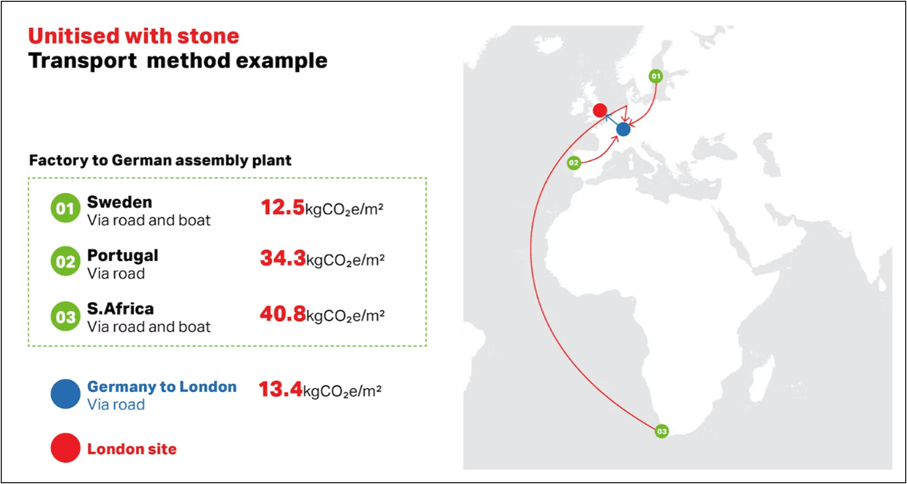
The transportation of facade materials and components to a factory, between factories, and to the building site can also have a big impact. Understanding this impact is important in determining the optimum design and specification for a low-carbon building.

Author: Make Architects

2023-07-21

Demolishing unwanted buildings wastes vast quantities of valuable resources, driving up financial and environmental costs. Deconstruction offers a means of salvaging materials for reuse. It also creates more jobs than demolition, spurs local innovation and industry, preserves local character and heritage, reduces landfill costs and limits the need for virgin (and often carbon-intensive) materials.

2023-07-21

The role of plastic materials in construction has become indispensable in the past decades with regard to the global megatrends urbanisation, climate, health, environment and affordable housing. 

2023-07-21

In recent years, awareness of the negative impacts of plastic waste and pollution on our environment has heightened. Popular television documentaries, such as the BBC’s Blue Planet II, and mainstream media campaigns have played a significant role in bringing these issues to the forefront of the public’s consciousness.

The focus of this has largely been on single-use plastics from consumer products and packaging. There has been relatively little attention on the use of plastics in construction, both from a short and long-life perspective.

2023-07-21

Cross laminated timber (CLT) has become a well-known engineered timber product of global interest. The orthogonal, laminar structure allows its application as a full-size wall and floor element as well as a linear timber member, able to bear loads in- and out-of-plane.

This article provides a state-of-the-art report on some selected topics related to CLT, in particular production and technology, characteristic material properties, design and connections.

Authors:

2023-07-21

Renewable and biodegradable materials derived from biomass are attractive candidates to replace non-biodegradable petrochemical plastics. However, the mechanical performance and wet stability of biomass are generally insufficient for practical applications.

2023-07-21

Given increasing concerns for the marine environment and human health, as well as trade restrictions from Asian countries, plastics have become a great challenge for the United States.

This study addresses the seven commonly used plastics: low-density polyethylene/linear low-density polyethylene, high-density polyethylene, polyethylene terephthalate (PET), polypropylene, polystyrene, polyvinyl chloride, and other plastics.