Photo showing construction cranes. By Ej Yao via Unsplash

Life cycle stage

Life cycle thinking is a crucial part of planning, decision making, and actions to improve the sustainability of construction and building and construction materials. ​​A whole life cycle approach requires consideration of the environmental impact of material choices before the materials are even extracted, and then at each phase of the building lifecycle, from extraction to processing, installation, use and demolition. This means thinking about how the choice of materials affects everything from the functioning of regional ecosystems, to the amount of heating or cooling needed, and how, at the end of their use, these materials can provide a bank of resources to then be re-used. 

This approach is core to tackling the challenges of reducing whole life carbon emissions of buildings, improving material efficiency and the circularity of processes, making building materials chemically safer, and addressing social hotspots in the material life cycle. Failing to consider the whole life cycle in decision making can lead to unintended trade-offs between environmental, social or economic issues that inhibits progress towards sustainable development.

Policymakers play a crucial role to support stakeholders in decarbonizing materials throughout their entire life cycle, from extraction and processing to installation and demolition. Although there are various recommendations for individual stakeholders like manufacturers, architects, owners, and builders to improve the carbon footprints of buildings, these efforts often face challenges due to interdependencies, which means they cannot achieve significant impacts on their own. Instead, stakeholders need simultaneous support to take complementary actions.

5
Source: United Nations Environment Programme (2023). Building Materials and the Climate: Constructing a New Future. Nairobi

For instance, designers, owners, and communities may want to use more recycled materials, but they are hindered by the gap between supply and demand. Closing this gap requires cities to introduce and enforce building codes that promote the use of 'circular' material components, enabling the re-use of materials at the end-of-life. Even incremental improvements across different life cycle phases can synergistically contribute to reducing emissions more effectively than focusing on isolated changes.

Yet, to scale up and have a meaningful impact, all these shifts and improvements require coordinated efforts across producers, designers, builders, and communities, considering the entire life cycle of buildings.

The Hub features a range of research papers, guidance on methodology and case studies that demonstrate taking a whole life cycle approach to improving the sustainability of building materials. Additionally, some resources focus more on a particular life cycle stage, such as recommendations for end-of-life actions to improve circularity. These can be accessed by selecting a particular life cycle stage from the menu.

The Hub also supports the approach of the UNEP Life Cycle Initiative. This is a public-private, multi-stakeholder partnership enabling the global use of credible life cycle knowledge by private and public stakeholders, with building materials being a key focus area for promoting best practice in life cycle thinking.


Filters +
View results
2023-07-21

The increased attention paid to resource efficiency, sustainable use of natural resources and sustainable buildings has raised awareness of the potential of the building sector to contribute to Europe’s goals in these areas.

The Resource Efficiency Roadmap identifies the building sector as one of the sectors that is key to addressing the challenges of energy, climate change and resource efficiency. The Roadmap recognises that increased waste recycling, among other measures, will contribute to a competitive construction sector.

2023-07-21

Construction logistics offer useful solutions to improve both the productivity and sustainability of the industry. The purpose of this paper is to investigate, in detail, the environmental impact of construction transport and whether the building certification scheme for a construction project has any influence on its transport arrangements. The analysis in this paper is based on a multiple case study of 40 Swedish projects.

2023-07-21

Afghanistan has suffered from four decades of war, causing a massive migration of the rural population to the cities. Kabul was originally designed for 1,5 million people, whereas there are now 5 million in the city. The importation of modern western styles housing for rapid reconstruction reveals apparent cultural conflict and a significant environmental footprint.

2023-07-21

Glass is a highly recyclable material, despite which, end-of-life building glass is almost never recycled into new glass products.

In the UK alone, almost 200,000 tonnes of glass is currently sent to landfill each year. In the EU, the proper recycling of all building glass waste could avoid 925,000 tonnes of landfilled waste every year and save around 1.23 million tonnes of primary raw materials annually.

2023-07-21

The temperature of cities continues to increase because of the heat island phenomenon and the undeniable climatic change. The observed high ambient temperatures intensify the energy problem of cities, deteriorates comfort conditions, put in danger the vulnerable population and amplify the pollution problems.

2023-07-21

Over the past four decades, global plastics production has quadrupled. If this trend were to continue, the GHG emissions from plastics would reach 15% of the global carbon budget by 2050. Strategies to mitigate the life-cycle GHG emissions of plastics, however, have not been evaluated on a global scale.

2023-07-21

The transition to a carbon neutral EU requires deep energy demand reductions in key sectors of the economy such as buildings and transport, and that the remaining energy consumed is carbon neutral. Such transformations can only be achieved if the conditions are created for all actors and industrial sectors to maximise their multi-faceted contributions to this low-carbon revolution.

2023-07-12

Thanks to funding from Innovate UK, in collaboration with the NICER programme, a new ‘toolkit’ has been developed as part of the ASBP-led ‘Delivering Innovative Steel ReUse ProjecT‘ (DISRUPT).

2023-05-30

The Construction, Demolition & Deconstruction Policy Toolkit was developed by members of Recycle Colorado’s C&D Council, a group of industry stakeholders including public, private, and nonprofit sector entities working to support construction, demolition and deconstruction (C&D) materials recovery in Colorado.  The toolkit is currently in draft.

2023-05-30

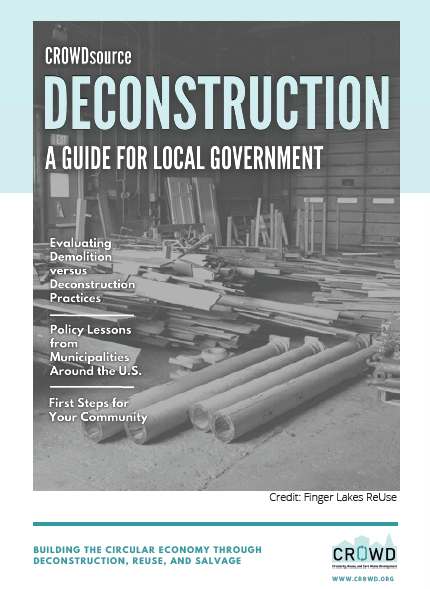
Evaluating demolition versus deconstruction practices - policy lessons from municipalitites around the US.

Faced with housing crises, aging building stock, landfill concerns, and climate impacts to the builtenvironment, municipalities and states are increasingly turning  their attention to deconstruction and building material reuse as an alternative to demolition.