Photo showing construction cranes. By Ej Yao via Unsplash

Life cycle stage

Life cycle thinking is a crucial part of planning, decision making, and actions to improve the sustainability of construction and building and construction materials. ​​A whole life cycle approach requires consideration of the environmental impact of material choices before the materials are even extracted, and then at each phase of the building lifecycle, from extraction to processing, installation, use and demolition. This means thinking about how the choice of materials affects everything from the functioning of regional ecosystems, to the amount of heating or cooling needed, and how, at the end of their use, these materials can provide a bank of resources to then be re-used. 

This approach is core to tackling the challenges of reducing whole life carbon emissions of buildings, improving material efficiency and the circularity of processes, making building materials chemically safer, and addressing social hotspots in the material life cycle. Failing to consider the whole life cycle in decision making can lead to unintended trade-offs between environmental, social or economic issues that inhibits progress towards sustainable development.

Policymakers play a crucial role to support stakeholders in decarbonizing materials throughout their entire life cycle, from extraction and processing to installation and demolition. Although there are various recommendations for individual stakeholders like manufacturers, architects, owners, and builders to improve the carbon footprints of buildings, these efforts often face challenges due to interdependencies, which means they cannot achieve significant impacts on their own. Instead, stakeholders need simultaneous support to take complementary actions.

5
Source: United Nations Environment Programme (2023). Building Materials and the Climate: Constructing a New Future. Nairobi

For instance, designers, owners, and communities may want to use more recycled materials, but they are hindered by the gap between supply and demand. Closing this gap requires cities to introduce and enforce building codes that promote the use of 'circular' material components, enabling the re-use of materials at the end-of-life. Even incremental improvements across different life cycle phases can synergistically contribute to reducing emissions more effectively than focusing on isolated changes.

Yet, to scale up and have a meaningful impact, all these shifts and improvements require coordinated efforts across producers, designers, builders, and communities, considering the entire life cycle of buildings.

The Hub features a range of research papers, guidance on methodology and case studies that demonstrate taking a whole life cycle approach to improving the sustainability of building materials. Additionally, some resources focus more on a particular life cycle stage, such as recommendations for end-of-life actions to improve circularity. These can be accessed by selecting a particular life cycle stage from the menu.

The Hub also supports the approach of the UNEP Life Cycle Initiative. This is a public-private, multi-stakeholder partnership enabling the global use of credible life cycle knowledge by private and public stakeholders, with building materials being a key focus area for promoting best practice in life cycle thinking.

Filters +
View results
2022-12-10

The risks of not curbing global warming are clear. The good news is that the built environment can play a massive role in drawing down emissions. But decarbonizing the built environment needs to advance now: New buildings and renovations of every type need to be built and operated to zero carbon emission standards. This is a collective endeavor. It will take every building in every community. The entire built environment sector, like the entire world of nations, is in this together.  

2022-12-10

The concept of environmental sustainability and its applications in the ceramic industry has been raised due to the environmental issues related to the construction sector. This study evaluated and compared the environmental impacts of ceramic tiles manufactured by the current production technologies. Four different cleaner scenarios are applied based on cradle-to-gate life cycle assessment.

2022-12-10

EIT Climate-KIC has teamed up with a cohort of partners to develop a handbook to help cities reduce embodied carbon in construction.

Globally, buildings account for 39 per cent of carbon emissions, with the share of embodied carbon (arising from manufacturing, transportation, installation, maintenance, and disposal of building materials) becoming more dominant as energy efficiency increases and energy sources become less carbon intensive. Therefore, dramatically reducing this source of emissions in the construction sector is a priority.

2022-12-09

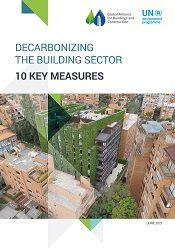
This publication aims to inspire senior officials and decision makers in national, subnational and local governments to decarbonize the building sector, and to show them how to start. It does not present a comprehensive strategy, but rather highlights a set of essential measures and successful examples from intervention areas identified in the GlobalABC Regional Roadmaps – new buildings, existing buildings, building operations, building materials, and resilience.

2022-12-09

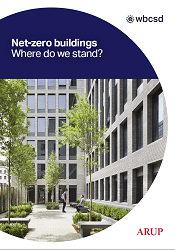
This report looks in detail at the results of six whole life cycle assessment (WLCA) case studies to illustrate some of the challenges, barriers and opportunities relating to the building industry’s carbon footprint. It aims to provide an insight into the industry’s current performance and compare it to possible net-zero trajectories.

Analyzing the whole life carbon emissions of six building projects using the WBCSD Building System Carbon Framework, the report shows that:

2022-12-09

The built environment is responsible for almost 40% of the global energy and process-related CO2 emissions. To meet the Paris Agreement and limit global warming to 1.5°C, we need to reach net-zero emissions across all activities in the building and construction system. The goal is for all new buildings to operate at net-zero emissions by 2030 at the latest, and for all buildings to operate at net zero by 2050.

2022-12-09

The MIT Concrete Sustainability Hub (CSHub) is a dedicated interdisciplinary team of researchers from several departments across MIT working on concrete and infrastructure science, engineering, and economics since 2009. The MIT CSHub brings together leaders from academia, industry, and government to develop breakthroughs using a holistic approach that will achieve durable and sustainable homes, buildings, and infrastructure in ever more demanding environments. Resources in the CSHub are largely focused upon the USA context, but are internationally applicable. 

2022-12-09

The IEA and IRENA Policies and Measures Database provides access to information on past, existing or planned government policies and measures to reduce greenhouse gas emissions, improve energy efficiency and support the development and deployment of renewables and other clean energy technologies.

2022-12-09

The Global Status Report for Buildings and Construction (Buildings-GSR) is a flagship publication of the UNEP-hosted Global Alliance for Buildings and Construction (GlobalABC). The Buildings-GSR provides an annual snapshot of the progress of the buildings and construction sector on a global scale and reviews the status of policies, finance, technologies, and solutions to monitor whether the sector is aligned with the Paris Agreement goals. It also provides stakeholders with evidence to persuade policymakers and the overall buildings and construction community to take action.

2022-12-09

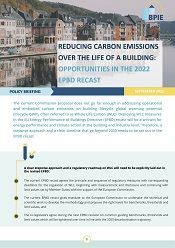
The current Commission proposal does not go far enough in addressing operational and embodied carbon emissions on building lifecycle global warming potential (lifecycle-GWP), often referred to as Whole Life Carbon (WLC). Deploying WLC measures in the EU Energy Performance of Buildings Directive (EPBD) recast will be a win-win for energy performance and climate action at the building and industry level. Therefore, a stepwise approach and a clear timeline that go beyond 2030 needs to be set out in the EPBD recast.