Photo showing palm trees by alevision.co, via Unsplash

Climate

It is vital to ensure that the selection of building materials is appropriate for the climate in which they are used. Material performance can strongly vary, depending on the conditions to which buildings are exposed. For example, some structural materials have more appropriate thermal properties for hot or tropical climates than others, enabling better heat retention or cooling when these properties are needed. Earth based construction is not a new strategy, but one that has fallen out of favour in the last century as preferences for materials such as concrete and steel grew.  Beyond being a more appropriate material choice in some contexts, earth construction can reduce the need for brick firing or production of synthetic binders and additives, reducing fuel and material consumption, as well as reducing health risks from air emissions and chemical use.

However, a material with improved sustainability performance in one region may not provide the same in-use performance in another, and a whole lifecycle thinking approach can help ensure that material choices are optimal. Additionally, sustainability hotspots can vary between regions. For example, there may be increased impacts from extraction in one region that are not experienced elsewhere, and from increased transportation distances. The expertise of installers with a material, ability of the local supply chain to meet demand and ensure quality, and the availability of infrastructure for end-of-life processing all bear consideration when determining if a material is appropriate for a particular climate.

6
Source: United Nations Environment Programme (2023). Building Materials and the Climate: Constructing a New Future. Nairobi

However, in some cases, learnings from material selection and market development can be transferred from one region to another where there are similarities in the climate. The Hub uses the Köppen-Geiger classification, which categorises regions as Tropical, Dry, and Temperate, according to the map below. Resources that apply to a particular climate are organised accordingly.

Map of Köppen-Geiger climate classification

map


Note: Tropical (A - regions Af, Am, Aw), Dry, (B - regions BWh, BWk, BSh, BSk) and Temperate (C - regions Csa, CSb) are used in the Sustainable Building Materials Hub to categorise resources where climate considerations apply.
Source: Beck, H.E., Zimmermann, N. E., McVicar, T. R., Vergopolan, N., Berg, A., & Wood, E. F., CC BY-SA 4.0 <https://creativecommons.org/licenses/by-sa/4.0>, via Wikimedia Commons
Filters +
View results
2022-01-01

The GreenScreen List Translator™ provides a “list of lists” approach to quickly identify chemicals of high concern. It does this by scoring chemicals based on information from over 40 hazard lists developed by authoritative scientific bodies convened by international, national and state governmental agencies, intergovernmental agencies and NGOs. These GreenScreen Specified Lists include REACH categorizations and chemical hazard classifications by countries using the Globally Harmonized System of Classification and Labelling of Chemicals (GHS).

2022-01-01

This short online course from the Life Cycle Initiative provides grounding on lifecycle thinking for policy makers. This is delivered via a series of video lessons, reading materials, and quizzes around the application of life cycle thinking in different areas of policy. The areas covered include those relevant to the built environment and urban planning, including transport and waste policy.

2022-01-01

HBN's Product Guidance uses a red-to-green ranking system to compare different types of products based on their hazardous content. It is informed by our comprehensive research into the hazards associated with building products that may impact building occupants as well as fenceline communities and workers throughout the product's life cycle.

2021-11-01

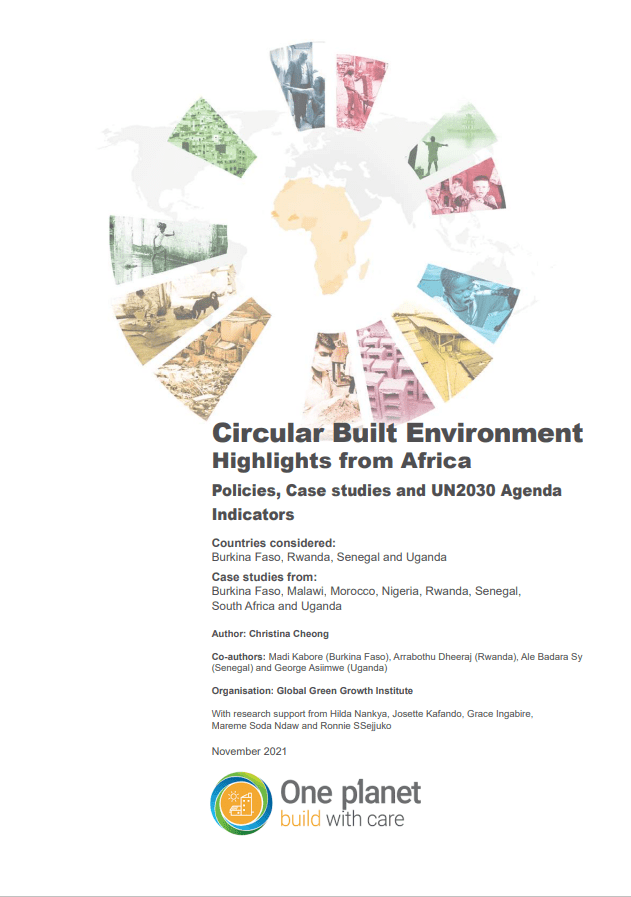
Policy briefing paper focusing on four countries in Africa: Burkina Faso, Rwanda, Senegal and Uganda. Through policy analysis and stakeholder interviews, this report presents the operating context for the building industry in these countries and the concept of circularity through all phases of the building life cycle. Nineteen of these examples are featured as case studies in this report and provide insights to the current initiatives on circularity in buildings. Case studies featured also include projects and practices from Malawi, Morocco, Nigeria and South Africa. 

2021-09-01

Policy brief paper analysing the policy, legal and regulatory frameworks governing the cement sector in Nigeria, Africa, and examines the policies required to encourage increased use of bioenergy in cement production.

2021-09-01

A comprehensive resource for cities and other government bodies seeking to develop strategies, action plans and policies to tackle embodied carbon. The report identifies and assesses policy types and urban planning approaches to create a sustainable built environment in terms of embodied carbon, with best practices drawn mostly from cities in Europe and North America alongside new policies that have yet to be implemented.

2021-09-01

Study into the key aspects of international best practices of green public procurement policies that can be adopted in the USA for successful design and implementation of the Federal Buy Clean initiative. The Buy Clean initiative calls for the prioritisation of American-made, lower-carbon construction materials in federal procurement and federally assisted projects in North America.


2021-08-01

User-friendly overview of proven and scalable solutions to reduce concrete’s contribution to climate change. This guide highlights six key opportunities to reduce embodied carbon in concrete products without compromising financial or material performance.

2021-07-05

The SDG 12 Hub is a one-stop-shop for governments, businesses, civil society and the public for tracking progress on the achievement of Goal 12 of the 2030 Agenda for Sustainable Development: ensuring sustainable consumption and production patterns.

The SDG 12 Hub supports the transformation to sustainable consumption and production practices by offering direct access to transparent data, impactful solutions, guidance and official reporting all in one place, and facilitates the sharing of progress, knowledge and solutions for sustainable consumption and production.

2021-06-25

With the ÖKOBAUDAT platform, the Federal Ministry for Housing, Urban Development and Building (BMWSB) Germany provides all stakeholders with a standardized database for the life cycle assessment of buildings. At the heart of the platform is the online database with life cycle assessment data on building materials, construction, transport, energy and disposal processes. With the help of life cycle assessment tools, such as the eLCA provided by the BBSR, the entire life cycle of a building can be compiled with the ÖKOBAUDAT database.