Photo showing palm trees by alevision.co, via Unsplash

Climate

It is vital to ensure that the selection of building materials is appropriate for the climate in which they are used. Material performance can strongly vary, depending on the conditions to which buildings are exposed. For example, some structural materials have more appropriate thermal properties for hot or tropical climates than others, enabling better heat retention or cooling when these properties are needed. Earth based construction is not a new strategy, but one that has fallen out of favour in the last century as preferences for materials such as concrete and steel grew.  Beyond being a more appropriate material choice in some contexts, earth construction can reduce the need for brick firing or production of synthetic binders and additives, reducing fuel and material consumption, as well as reducing health risks from air emissions and chemical use.

However, a material with improved sustainability performance in one region may not provide the same in-use performance in another, and a whole lifecycle thinking approach can help ensure that material choices are optimal. Additionally, sustainability hotspots can vary between regions. For example, there may be increased impacts from extraction in one region that are not experienced elsewhere, and from increased transportation distances. The expertise of installers with a material, ability of the local supply chain to meet demand and ensure quality, and the availability of infrastructure for end-of-life processing all bear consideration when determining if a material is appropriate for a particular climate.

6
Source: United Nations Environment Programme (2023). Building Materials and the Climate: Constructing a New Future. Nairobi

However, in some cases, learnings from material selection and market development can be transferred from one region to another where there are similarities in the climate. The Hub uses the Köppen-Geiger classification, which categorises regions as Tropical, Dry, and Temperate, according to the map below. Resources that apply to a particular climate are organised accordingly.

Map of Köppen-Geiger climate classification

map


Note: Tropical (A - regions Af, Am, Aw), Dry, (B - regions BWh, BWk, BSh, BSk) and Temperate (C - regions Csa, CSb) are used in the Sustainable Building Materials Hub to categorise resources where climate considerations apply.
Source: Beck, H.E., Zimmermann, N. E., McVicar, T. R., Vergopolan, N., Berg, A., & Wood, E. F., CC BY-SA 4.0 <https://creativecommons.org/licenses/by-sa/4.0>, via Wikimedia Commons
Filters +
View results
2022-11-30

Canada's national guidelines for whole-building life cycle assessment.  This document provides comprehensive instruction for the practice of life cycle assessment applied to buildings, based on relevant standards and keyed to various intentions. The goal is to harmonize the practice of whole-building life cycle assessment (wbLCA) across different studies and assist in interpretation of and compliance with relevant standards. This resource can support the development of similar guideline policies in North America and internationally.

2022-11-29

Guidance exploring ways circular economy business models provide added benefits, such as eco-innovation, throughout the value chain in construction.

2022-11-28

The Carbon Leadership Forum has created a Carbon Policy Toolkit, found here— an array of resources to support the crafting of policies to radically reduce embodied carbon in North America, the USA, and beyond. 

2022-11-28

Design and construction teams have a growing number of strategies and tools to choose from to reduce embodied carbon in their projects. This template, found here, provides a checklist for project teams in North America (USA) to use and adapt. The template makes it easier for teams to systematically discuss if they have considered strategies that may be relevant to their projects.

2022-11-28

The Embodied Carbon in Construction Calculator (EC3) tool is a free and easy-to-use tool that allows benchmarking, assessment and reductions in embodied carbon, focused on the upfront supply chain emissions of construction materials.

2022-10-05

This best practice guide to Materials Passports, by BAMB (Buildings as Materials Banks), provides a guide for actors along the construction value chain and shows the benefits of materials passports and how these can be implemented into general building practice. The publication also provides an overview of the types of material and product-related information.  

2022-10-05

The BRIC project is an educational tool to raise awareness and inform trainers and the construction and education sector about the circular economy in Europe. 

2022-10-01

The Clean Construction Policy Explorer on the C40 Knowledge Hub is an interactive dashboard showing how cities around the world are supporting the transition towards a resource-efficient and low- to zero-emissions construction sector. The map is a living document and C40 will keep it up to date as new policies are developed.

2022-05-01

This paper describes how, when substituted for concrete and steel, mass timber is a carbon-absorbing, energy-efficient, lower-cost, durable and mendable building material that can help deliver affordable urban housing and rural livelihood opportunities. It is suitable for Africa, where trees grow faster than in temperate climates. Africa can mitigate climate change and achieve other developmental benefits using mass timber in its construction sector. Governments and other development actors can support the transition.

2022-02-15

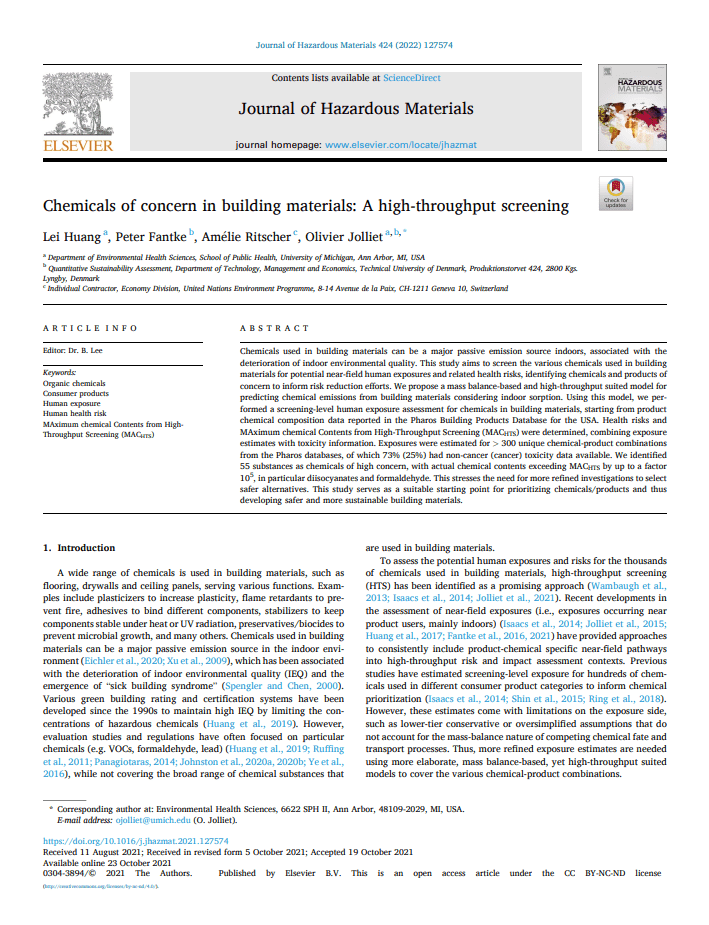
This study aims to screen the various chemicals used in building materials for potential near-field human exposures and related health risks, identifying chemicals and products of concern to inform risk reduction efforts.