Photo showing construction cranes. By Ej Yao via Unsplash

Life cycle stage

Life cycle thinking is a crucial part of planning, decision making, and actions to improve the sustainability of construction and building and construction materials. ​​A whole life cycle approach requires consideration of the environmental impact of material choices before the materials are even extracted, and then at each phase of the building lifecycle, from extraction to processing, installation, use and demolition. This means thinking about how the choice of materials affects everything from the functioning of regional ecosystems, to the amount of heating or cooling needed, and how, at the end of their use, these materials can provide a bank of resources to then be re-used. 

This approach is core to tackling the challenges of reducing whole life carbon emissions of buildings, improving material efficiency and the circularity of processes, making building materials chemically safer, and addressing social hotspots in the material life cycle. Failing to consider the whole life cycle in decision making can lead to unintended trade-offs between environmental, social or economic issues that inhibits progress towards sustainable development.

Policymakers play a crucial role to support stakeholders in decarbonizing materials throughout their entire life cycle, from extraction and processing to installation and demolition. Although there are various recommendations for individual stakeholders like manufacturers, architects, owners, and builders to improve the carbon footprints of buildings, these efforts often face challenges due to interdependencies, which means they cannot achieve significant impacts on their own. Instead, stakeholders need simultaneous support to take complementary actions.

5
Source: United Nations Environment Programme (2023). Building Materials and the Climate: Constructing a New Future. Nairobi

For instance, designers, owners, and communities may want to use more recycled materials, but they are hindered by the gap between supply and demand. Closing this gap requires cities to introduce and enforce building codes that promote the use of 'circular' material components, enabling the re-use of materials at the end-of-life. Even incremental improvements across different life cycle phases can synergistically contribute to reducing emissions more effectively than focusing on isolated changes.

Yet, to scale up and have a meaningful impact, all these shifts and improvements require coordinated efforts across producers, designers, builders, and communities, considering the entire life cycle of buildings.

The Hub features a range of research papers, guidance on methodology and case studies that demonstrate taking a whole life cycle approach to improving the sustainability of building materials. Additionally, some resources focus more on a particular life cycle stage, such as recommendations for end-of-life actions to improve circularity. These can be accessed by selecting a particular life cycle stage from the menu.

The Hub also supports the approach of the UNEP Life Cycle Initiative. This is a public-private, multi-stakeholder partnership enabling the global use of credible life cycle knowledge by private and public stakeholders, with building materials being a key focus area for promoting best practice in life cycle thinking.

Filters +
View results
2022-11-30

Canada's national guidelines for whole-building life cycle assessment.  This document provides comprehensive instruction for the practice of life cycle assessment applied to buildings, based on relevant standards and keyed to various intentions. The goal is to harmonize the practice of whole-building life cycle assessment (wbLCA) across different studies and assist in interpretation of and compliance with relevant standards. This resource can support the development of similar guideline policies in North America and internationally.

2022-11-29

Guidance exploring ways circular economy business models provide added benefits, such as eco-innovation, throughout the value chain in construction.

2022-11-28

The Carbon Leadership Forum has created a Carbon Policy Toolkit, found here— an array of resources to support the crafting of policies to radically reduce embodied carbon in North America, the USA, and beyond. 

2022-11-28

Design and construction teams have a growing number of strategies and tools to choose from to reduce embodied carbon in their projects. This template, found here, provides a checklist for project teams in North America (USA) to use and adapt. The template makes it easier for teams to systematically discuss if they have considered strategies that may be relevant to their projects.

2022-11-28

The Embodied Carbon in Construction Calculator (EC3) tool is a free and easy-to-use tool that allows benchmarking, assessment and reductions in embodied carbon, focused on the upfront supply chain emissions of construction materials.

2022-10-05

This best practice guide to Materials Passports, by BAMB (Buildings as Materials Banks), provides a guide for actors along the construction value chain and shows the benefits of materials passports and how these can be implemented into general building practice. The publication also provides an overview of the types of material and product-related information.  

2022-10-05

The BRIC project is an educational tool to raise awareness and inform trainers and the construction and education sector about the circular economy in Europe. 

2022-10-01

The Clean Construction Policy Explorer on the C40 Knowledge Hub is an interactive dashboard showing how cities around the world are supporting the transition towards a resource-efficient and low- to zero-emissions construction sector. The map is a living document and C40 will keep it up to date as new policies are developed.

2022-05-01

This paper describes how, when substituted for concrete and steel, mass timber is a carbon-absorbing, energy-efficient, lower-cost, durable and mendable building material that can help deliver affordable urban housing and rural livelihood opportunities. It is suitable for Africa, where trees grow faster than in temperate climates. Africa can mitigate climate change and achieve other developmental benefits using mass timber in its construction sector. Governments and other development actors can support the transition.

2022-02-15

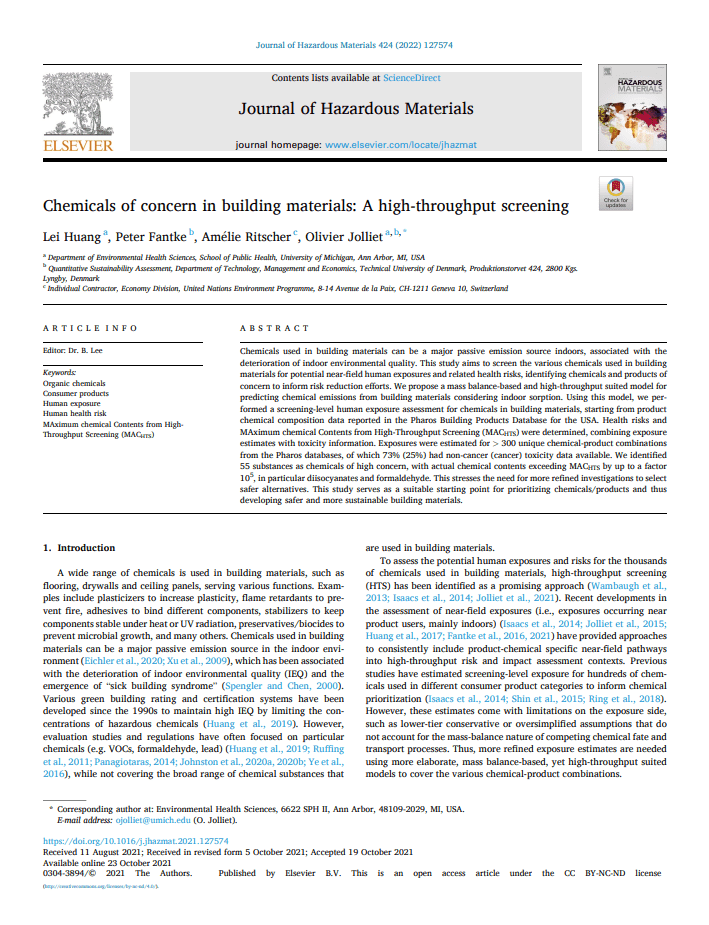
This study aims to screen the various chemicals used in building materials for potential near-field human exposures and related health risks, identifying chemicals and products of concern to inform risk reduction efforts.